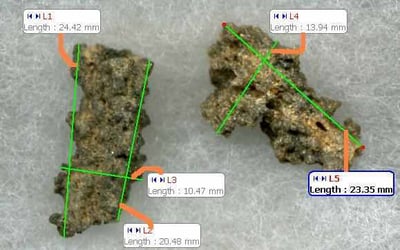
Schist
A variety of Metamorphic

What is Schist?
Schists are metamorphic rocks, usually formed from shale or mudstone, that have an abundance of large, platy grains – though what exactly those grains are made from varies greatly across specimens. Schist has few industrial uses, though this rock can host large, gem-quality crystals, including garnets, emeralds, sapphires, and rubies.
Etymology & Origins
Before the mid-18th century, the terms slate, shale and schist were not sharply differentiated by those involved with mining.
Uses & Applications
Schist is a very durable rock, and because of that it has been used for centuries in construction. Buildings constructed from this rock can last for hundreds of years, and in addition to walls and flooring, it can be used in roofing and pillars. Schist is a common addition to many paints and is also used in jewelry.
Discover Values
Market Value Factors
Pricing varies for every rock and mineral, so use these universal factors to gauge Schist before comparing listings or appraisals.
Size & Weight
Larger, intact specimens usually command higher prices.
Rarity & Demand
Scarce material or popular varieties sell at a premium.
Condition & Finish
Chips, repairs, and heavy wear lower value; clean prep helps.
Treatment & Provenance
Untreated specimens with documented locality are prized.
Schist Localities Map
See where Schist is found with a localities map, collecting zones, and geology context. Generate a sample map preview below.
Key Characteristics
Formation of Schist
During metamorphism, rocks which were originally sedimentary, igneous or metamorphic are converted into schists and gneisses. If the composition of the rocks was originally similar, they may be very difficult to distinguish from one another if the metamorphism has been great. A quartz-porphyry, for example, and a fine grained feldspathic sandstone, may both be converted into a grey or pink mica-schist. Usually, however, it is possible to distinguish between sedimentary and igneous schists and gneisses. If, for example, the whole district occupied by these rocks has traces of bedding, clastic structure, or unconformability, then it may be a sign that the original rock was sedimentary.
More Images


Quick Facts
Physical Properties
- Color
- Gray, black, brown, green, etc.
- Hardness (Mohs)
- 4 - 6
- Density
- 2.8 - 2.9 g/cm³

Identify Schist Instantly
- Snap a photo, get instant results
- 6,700+ rocks, minerals & crystals
- Discover collecting spots near you
Schist FAQs
How do I identify Schist?
Schist can be identified by its hardness of 4 - 6 on the Mohs scale, Gray color. Look for these key characteristics when examining specimens.
What color is Schist?
Schist typically appears in Gray, black, brown, green, etc.. Color can vary depending on impurities and formation conditions.
How hard is Schist?
Schist has a hardness of 4 - 6 on the Mohs scale. This gives it moderate hardness.
What is the formation of schist of Schist?
During metamorphism, rocks which were originally sedimentary, igneous or metamorphic are converted into schists and gneisses. If the composition of the rocks was originally similar, they may be very difficult to distinguish from one another if the metamorphism has been great. A quartz-porphyry, for example, and a fine grained feldspathic sandstone, may both be converted into a grey or pink mica-schist. Usually, however, it is possible to distinguish between sedimentary and igneous schists and gneisses. If, for example, the whole district occupied by these rocks has traces of bedding, clastic structure, or unconformability, then it may be a sign that the original rock was sedimentary.