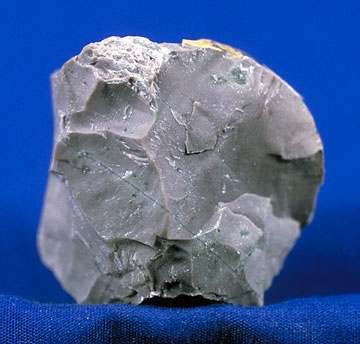
Stromatolite
A variety of Sedimentary

What is Stromatolite?
A stromatolite is not a specific type of rock, per se, but is rather a specific sedimentary formation. Stromatolites are created when adhesive compounds, generated by oceanic cyanobacteria, work to glue together many grains of sand or other small rocks, creating columns or pillow-like formations. Most stromatolites that we know about today are fossilized, having been formed by bacteria hundreds of millions of years ago.
Uses & Applications
When polished, stromatolite can be used as a decorative stone, but it has very few uses outside of that. For paleontologists and geologists, this rock is seen as one of the earliest indicators of bacterial life, and as such is a popular exhibit item in museums.
Discover Values
This stone excels in cultural value.
Market Value Factors
Pricing varies for every rock and mineral, so use these universal factors to gauge Stromatolite before comparing listings or appraisals.
Size & Weight
Larger, intact specimens usually command higher prices.
Rarity & Demand
Scarce material or popular varieties sell at a premium.
Condition & Finish
Chips, repairs, and heavy wear lower value; clean prep helps.
Treatment & Provenance
Untreated specimens with documented locality are prized.
Stromatolite Localities Map
See where Stromatolite is found with a localities map, collecting zones, and geology context. Generate a sample map preview below.
Key Characteristics
Formation of Stromatolite
Time lapse photography of modern microbial mat formation in a laboratory setting gives some revealing clues to the behavior of cyanobacteria in stromatolites. Biddanda et al. (2015) found that cyanobacteria exposed to localized beams of light moved towards the light, or expressed phototaxis, and increased their photosynthetic yield, which is necessary for survival. In a novel experiment, the scientists projected a school logo onto a petri dish containing the organisms, which accreted beneath the lighted region, forming the logo in bacteria. The authors speculate that such motility allows the cyanobacteria to seek light sources to support the colony. In both light and dark conditions, the cyanobacteria form clumps that then expand outwards, with individual members remaining connected to the colony via long tendrils. This may be a protective mechanism that affords evolutionary benefit to the colony in harsh environments where mechanical forces act to tear apart the microbial mats. Thus these sometimes elaborate structures, constructed by microscopic organisms working somewhat in unison, are a means of providing shelter and protection from a harsh environment.
More Images


Quick Facts
Physical Properties
- Color
- Brown, black, beige, reddish-brown, yellow, white, grey, etc.
- Hardness (Mohs)
- 3 - 4

Identify Stromatolite Instantly
- Snap a photo, get instant results
- 6,700+ rocks, minerals & crystals
- Discover collecting spots near you
Stromatolite FAQs
How do I identify Stromatolite?
Stromatolite can be identified by its hardness of 3 - 4 on the Mohs scale, Brown color. Look for these key characteristics when examining specimens.
What color is Stromatolite?
Stromatolite typically appears in Brown, black, beige, reddish-brown, yellow, white, grey, etc.. Color can vary depending on impurities and formation conditions.
How hard is Stromatolite?
Stromatolite has a hardness of 3 - 4 on the Mohs scale. This makes it a soft mineral that can be scratched easily.
What is the formation of stromatolite of Stromatolite?
Time lapse photography of modern microbial mat formation in a laboratory setting gives some revealing clues to the behavior of cyanobacteria in stromatolites. Biddanda et al. (2015) found that cyanobacteria exposed to localized beams of light moved towards the light, or expressed phototaxis, and increased their photosynthetic yield, which is necessary for survival. In a novel experiment, the scientists projected a school logo onto a petri dish containing the organisms, which accreted beneath the lighted region, forming the logo in bacteria. The authors speculate that such motility allows the cyanobacteria to seek light sources to support the colony. In both light and dark conditions, the cyanobacteria form clumps that then expand outwards, with individual members remaining connected to the colony via long tendrils. This may be a protective mechanism that affords evolutionary benefit to the colony in harsh environments where mechanical forces act to tear apart the microbial mats. Thus these sometimes elaborate structures, constructed by microscopic organisms working somewhat in unison, are a means of providing shelter and protection from a harsh environment.