Pyrope Garnet
Pyrope
A variety of Garnet Group
What is Pyrope Garnet?
Brilliant pyrope Garnet makes a beautiful addition to any piece of jewelry. As with other garnet family members, pieces of pyrope Garnet that are not gem-worthy are sent to the crusher to be transformed into specialized sandpaper called garnet paper.
Optical Properties
- Refractive Index
- 1.720-1.756
- Pleochroism
- None
- Optical Character
- Isotropic
- Dispersion
- 0.022
Discover Values
Market Value Factors
Pricing varies for every rock and mineral, so use these universal factors to gauge Pyrope Garnet before comparing listings or appraisals.
Size & Weight
Larger, intact specimens usually command higher prices.
Rarity & Demand
Scarce material or popular varieties sell at a premium.
Condition & Finish
Chips, repairs, and heavy wear lower value; clean prep helps.
Treatment & Provenance
Untreated specimens with documented locality are prized.
Pyrope Garnet Localities Map
See where Pyrope Garnet is found with a localities map, collecting zones, and geology context. Generate a sample map preview below.
Key Characteristics
Characteristics of Pyrope Garnet
In petrographic thin section, the most distinguishing features of pyrope are those shared with the other common garnets: high relief and isotropy. Garnets tend to be less strongly coloured than other silicate minerals in thin section, although pyrope may show a pale pinkish-purple hue in plane-polarized light. The lack of cleavage, commonly euhedral crystal morphology, and mineral associations should also be used in identification of pyrope under the microscope.
Formation of Pyrope Garnet
The origin of most pyrope is in ultramafic rocks, typically peridotite from the Earth's mantle: these mantle-derived peridotites can be attributed both to igneous and metamorphic processes. Pyrope also occurs in ultrahigh-pressure (UHP) metamorphic rocks, as in the Dora-Maira massif in the western Alps. In that massif, nearly pure pyrope occurs in crystals to almost 12 cm in diameter; some of that pyrope has inclusions of coesite, and some has inclusions of enstatite and sapphirine.
Quick Facts
Physical Properties
- Color
- Blood red, orange red, purple red, pink, black red, colorless
- Hardness (Mohs)
- 7.5
- Density
- 3.582 g/cm³
- Streak
- White
- Luster
- Vitreous
- Crystal System
- Isometric
Chemical Properties
- Chemical Formula
- Mg3Al2(SiO4)3
- Elements
- Al, Mg, O, Si
Also Known As
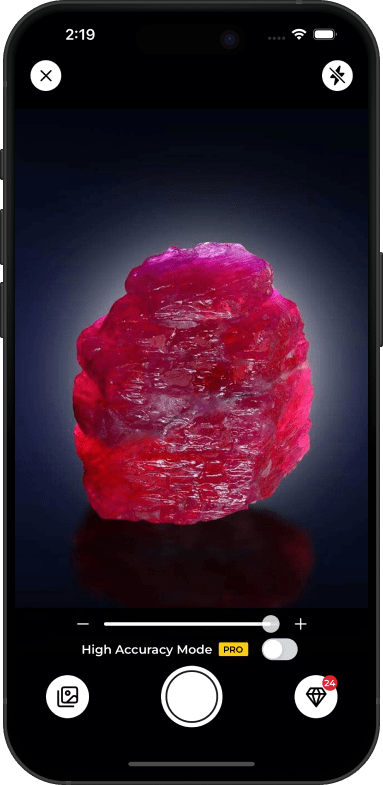
Identify Pyrope Garnet Instantly
- Snap a photo, get instant results
- 6,700+ rocks, minerals & crystals
- Discover collecting spots near you
Pyrope Garnet FAQs
How do I identify Pyrope Garnet?
Pyrope Garnet can be identified by its hardness of 7.5 on the Mohs scale, Blood red color, Vitreous luster, Isometric crystal system. Look for these key characteristics when examining specimens.
What color is Pyrope Garnet?
Pyrope Garnet typically appears in Blood red, orange red, purple red, pink, black red, colorless. Color can vary depending on impurities and formation conditions.
How hard is Pyrope Garnet?
Pyrope Garnet has a hardness of 7.5 on the Mohs scale. This makes it a relatively hard mineral suitable for jewelry.
What is the characteristics of pyrope garnet of Pyrope Garnet?
In petrographic thin section, the most distinguishing features of pyrope are those shared with the other common garnets: high relief and isotropy. Garnets tend to be less strongly coloured than other silicate minerals in thin section, although pyrope may show a pale pinkish-purple hue in plane-polarized light. The lack of cleavage, commonly euhedral crystal morphology, and mineral associations should also be used in identification of pyrope under the microscope.
What is the formation of pyrope garnet of Pyrope Garnet?
The origin of most pyrope is in ultramafic rocks, typically peridotite from the Earth's mantle: these mantle-derived peridotites can be attributed both to igneous and metamorphic processes. Pyrope also occurs in ultrahigh-pressure (UHP) metamorphic rocks, as in the Dora-Maira massif in the western Alps. In that massif, nearly pure pyrope occurs in crystals to almost 12 cm in diameter; some of that pyrope has inclusions of coesite, and some has inclusions of enstatite and sapphirine.