Almandine Garnet
Almandine
A variety of Garnet Group
What is Almandine Garnet?
The beautifully rich color of almandine Garnet is an excellent clue that it is part of the garnet family. It can be found globally and is often used in jewelry and other decorative objects. When ground down, it is used to create very special sandpaper called "garnet paper." Surprisingly, the discovery of one of the largest specimens of this mineral was in midtown Manhatten!
Optical Properties
- Refractive Index
- 1.770-1.820
- Pleochroism
- None
- Optical Character
- Isotropic
- Dispersion
- 0.027
Discover Values
Market Value Factors
Pricing varies for every rock and mineral, so use these universal factors to gauge Almandine Garnet before comparing listings or appraisals.
Size & Weight
Larger, intact specimens usually command higher prices.
Rarity & Demand
Scarce material or popular varieties sell at a premium.
Condition & Finish
Chips, repairs, and heavy wear lower value; clean prep helps.
Treatment & Provenance
Untreated specimens with documented locality are prized.
Almandine Garnet Localities Map
See where Almandine Garnet is found with a localities map, collecting zones, and geology context. Generate a sample map preview below.
Key Characteristics
Formation of Almandine Garnet
Almandine occurs rather abundantly in the gem-gravels of Sri Lanka, whence it has sometimes been called Ceylon-ruby. When the color inclines to a violet tint, the stone is often called Syriam garnet, a name said to be taken from Syriam, an ancient town of Pegu (now part of Myanmar). Large deposits of fine almandine-garnets were found, some years ago, in the Northern Territory of Australia, and were at first taken for rubies and thus they were known in trade for some time afterwards as Australian rubies. Almandine is widely distributed. Fine rhombic dodecahedra occur in the schistose rocks of the Zillertal, in Tyrol, and are sometimes cut and polished. An almandine in which the ferrous oxide is replaced partly by magnesia is found at Luisenfeld in German East Africa. In the United States there are many localities which yield almandine. Fine crystals of almandine embedded in mica-schist occur near Wrangell in Alaska. The coarse varieties of almandine are often crushed for use as an abrasive agent.
Quick Facts
Physical Properties
- Color
- Deep red, brownish red, red-violet, black
- Hardness (Mohs)
- 7 - 7.5
- Density
- 4.313 g/cm³
- Streak
- White
- Luster
- Vitreous, Resinous
- Crystal System
- Isometric
Chemical Properties
- Chemical Formula
- Fe2+3Al2(SiO4)3
- Elements
- Al, Fe, O, Si
Also Known As
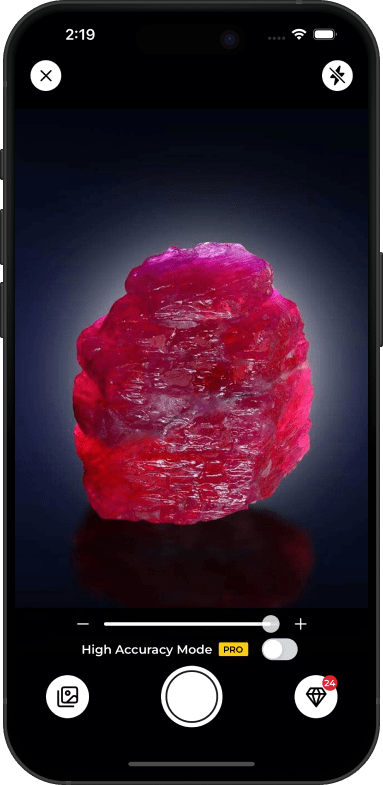
Identify Almandine Garnet Instantly
- Snap a photo, get instant results
- 6,700+ rocks, minerals & crystals
- Discover collecting spots near you
Almandine Garnet FAQs
How do I identify Almandine Garnet?
Almandine Garnet can be identified by its hardness of 7 - 7.5 on the Mohs scale, Deep red color, Vitreous, Resinous luster, Isometric crystal system. Look for these key characteristics when examining specimens.
What color is Almandine Garnet?
Almandine Garnet typically appears in Deep red, brownish red, red-violet, black. Color can vary depending on impurities and formation conditions.
How hard is Almandine Garnet?
Almandine Garnet has a hardness of 7 - 7.5 on the Mohs scale. This makes it a relatively hard mineral suitable for jewelry.
What is the formation of almandine garnet of Almandine Garnet?
Almandine occurs rather abundantly in the gem-gravels of Sri Lanka, whence it has sometimes been called Ceylon-ruby. When the color inclines to a violet tint, the stone is often called Syriam garnet, a name said to be taken from Syriam, an ancient town of Pegu (now part of Myanmar). Large deposits of fine almandine-garnets were found, some years ago, in the Northern Territory of Australia, and were at first taken for rubies and thus they were known in trade for some time afterwards as Australian rubies. Almandine is widely distributed. Fine rhombic dodecahedra occur in the schistose rocks of the Zillertal, in Tyrol, and are sometimes cut and polished. An almandine in which the ferrous oxide is replaced partly by magnesia is found at Luisenfeld in German East Africa. In the United States there are many localities which yield almandine. Fine crystals of almandine embedded in mica-schist occur near Wrangell in Alaska. The coarse varieties of almandine are often crushed for use as an abrasive agent.