Yuksporite
A variety of Minerals

What is Yuksporite?
Yuksporite is a rare inosilicate mineral with double width, unbranched chains, and the complicated chemical formula K4(Ca,Na)14Sr2Mn(Ti,Nb)4(O,OH)4(Si6O17)2(Si2O7)3(H2O,OH)3. It contains the relatively rare elements strontium, titanium and niobium, as well as the commoner metallic elements potassium, calcium, sodium and manganese. As with all silicates, it contains groups of linked silicon and oxygen atoms, as well as some associated water molecules. Yuksporite is a member of the umbite group that has just two known members, umbite, K2ZrSi3O9.H2O, and yuksporite. It was first reported in 1922, from nepheline syenite occurrences in the Kola Peninsula, Russia, and named by Alexander Fersman for the locality, near Mount Yukspor.
Market Value Factors
Pricing varies for every rock and mineral, so use these universal factors to gauge Yuksporite before comparing listings or appraisals.
Size & Weight
Larger, intact specimens usually command higher prices.
Rarity & Demand
Scarce material or popular varieties sell at a premium.
Condition & Finish
Chips, repairs, and heavy wear lower value; clean prep helps.
Treatment & Provenance
Untreated specimens with documented locality are prized.
Yuksporite Localities Map
See where Yuksporite is found with a localities map, collecting zones, and geology context. Generate a sample map preview below.
Key Characteristics
Characteristics of Yuksporite
Yuksporite is a biaxial mineral, but most authors do not specify whether it is (+) or (-); the Handbook of Mineralogy gives it as (+). All agree, however, that the refractive indices are Nx = 1.644 and Nz = 1.660 (with Ny unspecified), which are larger than those for quartz, but similar to those for tourmaline. Yuksporite shows pleochroism, with X pale rose-yellow, and Y, Z rose-yellow. It has a hardness of 4 ⁄2 to 5, between fluorite and apatite, and specific gravity 3.05, similar to fluorite. It exhibits barely detectable radioactivity.
Appearance of Yuksporite
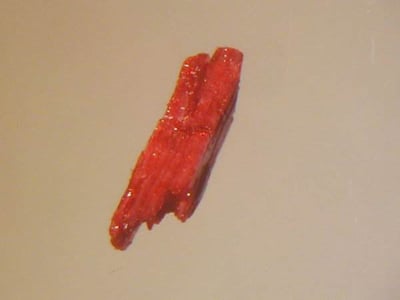
The mineral is brownish pink, rose pink or yellowish in color, with a silky to vitreous luster and a nearly white streak. It occurs in semi-transparent fibrous, scaly or lamellar aggregates up to 10 cm across.
More Images

Quick Facts
Physical Properties
- Color
- Brownish pink to red
- Streak
- Nearly white
Chemical Properties
- Chemical Formula
- K4(Ca,Na)14(Sr,Ba)2(◻,Mn,Fe)(Ti,Nb)4(O,OH)4(Si6O17)2(Si2O7)3(H2O,OH)3
- Elements
- Ba, Ca, Fe, H, K, Mn, Na, Nb, O, Si, Sr, Ti
Identify Yuksporite Instantly
- Snap a photo, get instant results
- 6,700+ rocks, minerals & crystals
- Discover collecting spots near you
Yuksporite FAQs
How do I identify Yuksporite?
Yuksporite can be identified by its Brownish pink to red color. Look for these key characteristics when examining specimens.
What color is Yuksporite?
Yuksporite typically appears in Brownish pink to red. Color can vary depending on impurities and formation conditions.
What is the characteristics of yuksporite of Yuksporite?
Yuksporite is a biaxial mineral, but most authors do not specify whether it is (+) or (-); the Handbook of Mineralogy gives it as (+). All agree, however, that the refractive indices are Nx = 1.644 and Nz = 1.660 (with Ny unspecified), which are larger than those for quartz, but similar to those for tourmaline. Yuksporite shows pleochroism, with X pale rose-yellow, and Y, Z rose-yellow. It has a hardness of 4 ⁄2 to 5, between fluorite and apatite, and specific gravity 3.05, similar to fluorite. It exhibits barely detectable radioactivity.
What is the appearance of yuksporite of Yuksporite?
The mineral is brownish pink, rose pink or yellowish in color, with a silky to vitreous luster and a nearly white streak. It occurs in semi-transparent fibrous, scaly or lamellar aggregates up to 10 cm across.

%252FAbenakiite-(ce)-01.jpg&size=small)

