Villiaumite
A variety of Minerals
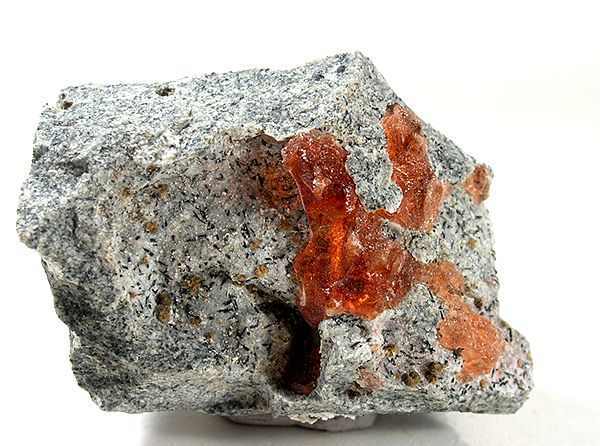
What is Villiaumite?
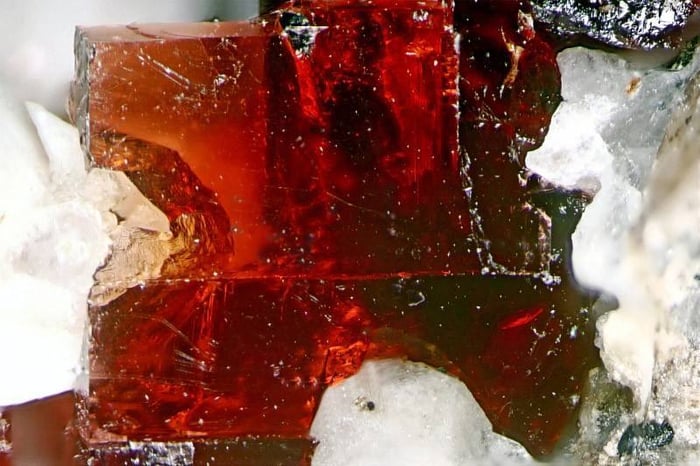
Villiaumite is a rare halide mineral composed of sodium fluoride, NaF. It is very soluble in water and some specimens fluoresce under long and short wave ultraviolet light. It has a Mohs hardness of 2.5 and is usually red, pink, or orange in color. It is toxic to humans. The red color is due to a broad absorption peaking at 512 nm. It is a result of radiation damage to the crystal.
Optical Properties
- Refractive Index
- 1.328-1.332
- Pleochroism
- Yellow to pink/deep carmine
- Optical Character
- Isotropic
Market Value Factors
Pricing varies for every rock and mineral, so use these universal factors to gauge Villiaumite before comparing listings or appraisals.
Size & Weight
Larger, intact specimens usually command higher prices.
Rarity & Demand
Scarce material or popular varieties sell at a premium.
Condition & Finish
Chips, repairs, and heavy wear lower value; clean prep helps.
Treatment & Provenance
Untreated specimens with documented locality are prized.
Villiaumite Localities Map
See where Villiaumite is found with a localities map, collecting zones, and geology context. Generate a sample map preview below.
Key Characteristics
Formation of Villiaumite
It occurs in nepheline syenite intrusives and in nepheline syenite pegmatites. It occurs associated with aegirine, sodalite, nepheline, neptunite, lamprophyllite, pectolite, serandite, eudialyte, ussingite, chkalovite and zeolites. It has been reported from Minas Gerais, Brazil; Mont Saint-Hilaire, Quebec, Canada; the Ilimaussaq complex of Greenland; Lake Magadi, Kenya; Windhoek District, Namibia; the Fen Complex, Telemark, Norway; the Khibiny and Lovozero Massifs, Kola Peninsula, Russia; Porphyry Mountain, Boulder County, Colorado and Point of Rocks Mesa, Colfax County, New Mexico, US. It was first described in 1908 for an occurrence in Los Islands, Guinea and named after the French explorer, Maxime Villiaume.
More Images
Quick Facts
Physical Properties
- Color
- Dark carmine-red, dark red, light orange, pink
- Hardness (Mohs)
- 2 - 2.5
- Density
- 2.81 g/cm³
- Streak
- White
Chemical Properties
- Chemical Formula
- NaF
- Elements
- F, Na
Identify Villiaumite Instantly
- Snap a photo, get instant results
- 6,700+ rocks, minerals & crystals
- Discover collecting spots near you
Villiaumite FAQs
How do I identify Villiaumite?
Villiaumite can be identified by its hardness of 2 - 2.5 on the Mohs scale, Dark carmine-red color. Look for these key characteristics when examining specimens.
What color is Villiaumite?
Villiaumite typically appears in Dark carmine-red, dark red, light orange, pink. Color can vary depending on impurities and formation conditions.
How hard is Villiaumite?
Villiaumite has a hardness of 2 - 2.5 on the Mohs scale. This makes it a soft mineral that can be scratched easily.
What is the formation of villiaumite of Villiaumite?
It occurs in nepheline syenite intrusives and in nepheline syenite pegmatites. It occurs associated with aegirine, sodalite, nepheline, neptunite, lamprophyllite, pectolite, serandite, eudialyte, ussingite, chkalovite and zeolites. It has been reported from Minas Gerais, Brazil; Mont Saint-Hilaire, Quebec, Canada; the Ilimaussaq complex of Greenland; Lake Magadi, Kenya; Windhoek District, Namibia; the Fen Complex, Telemark, Norway; the Khibiny and Lovozero Massifs, Kola Peninsula, Russia; Porphyry Mountain, Boulder County, Colorado and Point of Rocks Mesa, Colfax County, New Mexico, US. It was first described in 1908 for an occurrence in Los Islands, Guinea and named after the French explorer, Maxime Villiaume.

%252FAbenakiite-(ce)-01.jpg&size=small)

