Tetradymite
A variety of Minerals
What is Tetradymite?
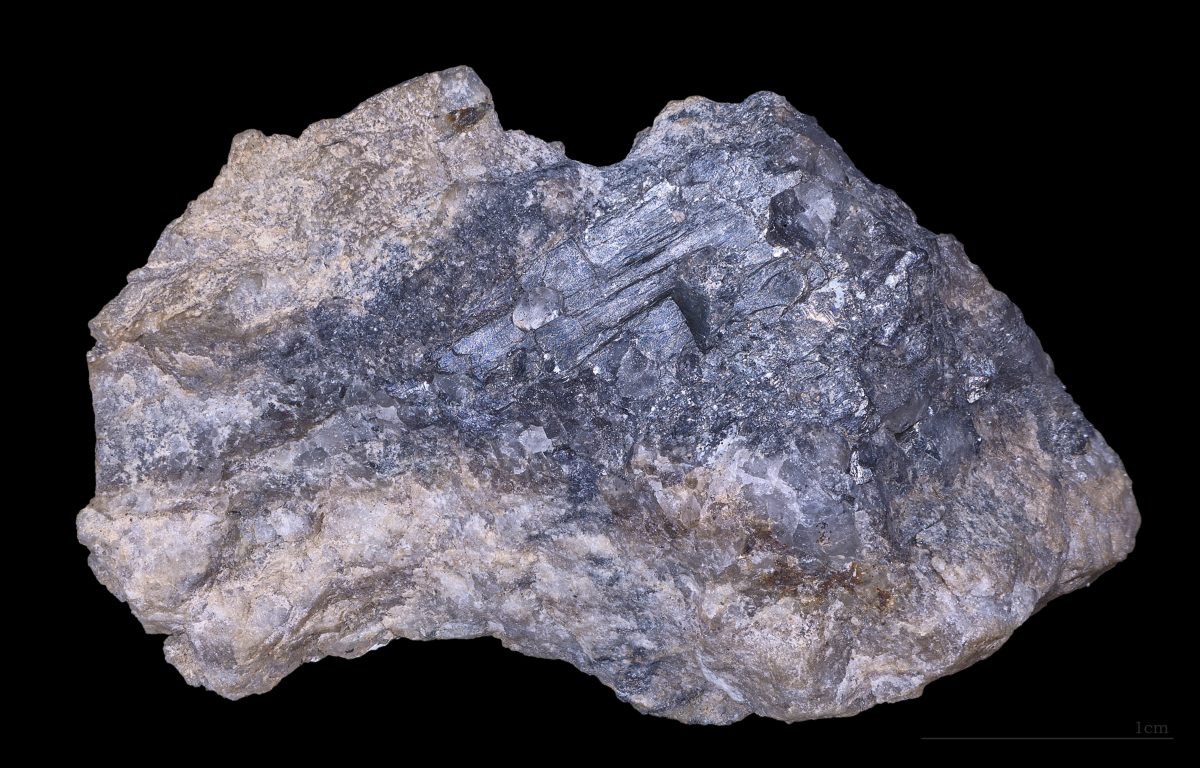
Tetradymite is a mineral consisting of bismuth, tellurium and sulfide, Bi2Te2S, also known as telluric bismuth. If sulfur is absent the mineral is tellurobismuthite and the formula is then Bi2Te3. Traces of selenium are usually present. Crystals are rhombohedral, but are rarely distinctly developed; they are twinned together in groups of four; hence the name of the mineral, from the Greek for fourfold. There is a perfect cleavage parallel to the basal plane and the mineral usually occurs in foliated masses of irregular outline. The color is steel-gray, and the luster metallic and brilliant. The mineral is very soft (H = 1.5 – 2) and marks paper. The specific gravity is 7.2 to 7.9. The type locality is Zupkov (Zsubko; Schubkau), Stredoslovenský Kraj, Slovak Republic where it was reported in 1831. It was first found, in 1815, at Telemark in Norway. It often occurs in high temperature hydrothermal quartz veins associated with native gold and in contact metamorphic deposits.
Market Value Factors
Pricing varies for every rock and mineral, so use these universal factors to gauge Tetradymite before comparing listings or appraisals.
Size & Weight
Larger, intact specimens usually command higher prices.
Rarity & Demand
Scarce material or popular varieties sell at a premium.
Condition & Finish
Chips, repairs, and heavy wear lower value; clean prep helps.
Treatment & Provenance
Untreated specimens with documented locality are prized.
Tetradymite Localities Map
See where Tetradymite is found with a localities map, collecting zones, and geology context. Generate a sample map preview below.
More Images

Quick Facts
Physical Properties
- Color
- Bright steel-gray, tin-white, tarnishes iridescent to dull
- Hardness (Mohs)
- 1.5 - 2
- Streak
- Pale steel-gray
Chemical Properties
- Chemical Formula
- Bi2Te2S Sulfur-rich tetradymite appears more chemically stable than stoichiometric Bi2Te2S, and the formula Bi14Te13S8 given by Pauling (1975) appears valid for most examples of natural tetradymite (Cook et al., 2007).
- Elements
- Bi, S, Te
Also Known As
Identify Tetradymite Instantly
- Snap a photo, get instant results
- 6,700+ rocks, minerals & crystals
- Discover collecting spots near you
Tetradymite FAQs
How do I identify Tetradymite?
Tetradymite can be identified by its hardness of 1.5 - 2 on the Mohs scale, Bright steel-gray color. Look for these key characteristics when examining specimens.
What color is Tetradymite?
Tetradymite typically appears in Bright steel-gray, tin-white, tarnishes iridescent to dull. Color can vary depending on impurities and formation conditions.
How hard is Tetradymite?
Tetradymite has a hardness of 1.5 - 2 on the Mohs scale. This makes it a soft mineral that can be scratched easily.

%252FAbenakiite-(ce)-01.jpg&size=small)

