Santabarbaraite
A variety of Minerals

What is Santabarbaraite?
Santabarbaraite is an amorphous ferric hydroxy phosphate mineral hydrate that was discovered in Tuscany, Italy in 2000. It also can be found in Victoria, Australia and Lake Baikal, Siberia. This phosphate mineral has a simplified formula Fe3(PO4)2(OH)3·5H2O, which is the same formula of another non-amorphous phosphate mineral called allanpringite. Santabarbaraite occurs as pseudomorphic masses after vivianite (Fe2(PO4)2·8H2O). In the process, monoclinic vivianite oxidizes to form the amorphous santabarbaraite. Pseudomorphism can be seen in Victoria, Australia in Wannon Falls which is originally a well-known locality for vivianite and at Lake Baikal, Siberia where the oxidized santabarbaraite can be seen as a rim surrounding vivianite due to exposure to air.
Market Value Factors
Pricing varies for every rock and mineral, so use these universal factors to gauge Santabarbaraite before comparing listings or appraisals.
Size & Weight
Larger, intact specimens usually command higher prices.
Rarity & Demand
Scarce material or popular varieties sell at a premium.
Condition & Finish
Chips, repairs, and heavy wear lower value; clean prep helps.
Treatment & Provenance
Untreated specimens with documented locality are prized.
Santabarbaraite Localities Map
See where Santabarbaraite is found with a localities map, collecting zones, and geology context. Generate a sample map preview below.
Key Characteristics
Characteristics of Santabarbaraite
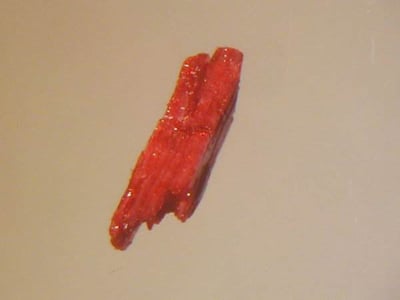
Santabarbaraite samples, due to pseudomorphism, show elongated and flattened prism habits. The bulk crystal color is brown to light brown and but appears yellow brown when viewed in an optical microscope. The mineral's streak color is also yellow-umber. Santabarbaraite has a vitreous to greasy luster and shows no fluorescence under ultra violet light. It is also translucent and shows good parting along the cleavage of its original mineral vivianite at {010}. Santabarbaraite's density is 2.24 g/cm. The mineral is isotropic with refractive index n=1.659.
Quick Facts
Physical Properties
- Color
- Orange, orange brown, yellowish-brown
- Density
- 2.42 g/cm³
- Streak
- yellow to yellowish-brown
Chemical Properties
- Chemical Formula
- Fe3+3(PO4)2(OH)3 · 5H2O
- Elements
- Fe, H, O, P
Also Known As
Identify Santabarbaraite Instantly
- Snap a photo, get instant results
- 6,700+ rocks, minerals & crystals
- Discover collecting spots near you
Santabarbaraite FAQs
How do I identify Santabarbaraite?
Santabarbaraite can be identified by its Orange color. Look for these key characteristics when examining specimens.
What color is Santabarbaraite?
Santabarbaraite typically appears in Orange, orange brown, yellowish-brown. Color can vary depending on impurities and formation conditions.
What is the characteristics of santabarbaraite of Santabarbaraite?
Santabarbaraite samples, due to pseudomorphism, show elongated and flattened prism habits. The bulk crystal color is brown to light brown and but appears yellow brown when viewed in an optical microscope. The mineral's streak color is also yellow-umber. Santabarbaraite has a vitreous to greasy luster and shows no fluorescence under ultra violet light. It is also translucent and shows good parting along the cleavage of its original mineral vivianite at {010}. Santabarbaraite's density is 2.24 g/cm. The mineral is isotropic with refractive index n=1.659.

%252FAbenakiite-(ce)-01.jpg&size=small)

