Rakovanite
A variety of Minerals

What is Rakovanite?
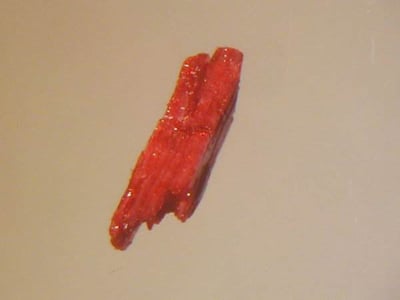
Rakovanite, Na3{H3[V10O28]}•15H20, is a member of the pascoite family. It is a transparent, brittle mineral occurring in the monoclinic crystal system. It is orange in color and has an orange-yellow colored streak. Rakovanite is soft with a Mohs hardness of 1 and a calculated density of 2.407g cm. It does not fluoresce in long- or short-wave ultraviolet radiation. Rakovanite crystals are up to one mm in maximum dimension and vary in habit from blocky to prismatic on [001], commonly exhibiting steps and striations parallel to [001]. Its name honors John Rakovan, professor, Department of Geology and Environmental Earth Science, Miami University, Oxford, Ohio, US.
Market Value Factors
Pricing varies for every rock and mineral, so use these universal factors to gauge Rakovanite before comparing listings or appraisals.
Size & Weight
Larger, intact specimens usually command higher prices.
Rarity & Demand
Scarce material or popular varieties sell at a premium.
Condition & Finish
Chips, repairs, and heavy wear lower value; clean prep helps.
Treatment & Provenance
Untreated specimens with documented locality are prized.
Rakovanite Localities Map
See where Rakovanite is found with a localities map, collecting zones, and geology context. Generate a sample map preview below.
Key Characteristics
Formation of Rakovanite
Rakovanite was found on specimens from the Sunday mine and the West Sunday mine, Slick Rock district, San Miguel County, Colorado, US. It occurs as crystalline crusts on sandstone fractures in the mine walls of the Sunday and West Sunday mines. The best crystals were found perched on an amorphous dehydrated vanadium phase along with crystals tightly adhered to a corvusite-montroseite matrix. It forms from the oxidation of montroseite-corvusite assemblages. It is associated calcite, corvusite, hewettite, hughesite, montroseite, munirite, paramontroseite, pascoite, rossite, sherwoodite, and other unidentified vanadium phases as well as at least two other potentially new decavanadate species. It forms aqueous solutions of relatively low pH when water reacts with pyrite in the deposit under ambient temperatures and generally oxidizing near-surface environments.
Composition of Rakovanite
Empirical formula (based on V = 10 apfu): (Na2.90K0.07Ca0.01Al0.01)ε2.99{H2.98[V10O28]}•15H2O; the ideal formula is Na3{H3[V10O28]}•15H2O calculated as ideal value for Na3{H3[V10O28]}•15H2O. Composition normalized to 100% using ideal H2O value from crystal structure results.
Quick Facts
Physical Properties
- Color
- orange
- Hardness (Mohs)
- 1
- Density
- 2.407 g/cm³
- Streak
- orange-yellow
Chemical Properties
- Chemical Formula
- Na3(H3V10O28) · 15H2O
- Elements
- H, Na, O, V
Identify Rakovanite Instantly
- Snap a photo, get instant results
- 6,700+ rocks, minerals & crystals
- Discover collecting spots near you
Rakovanite FAQs
How do I identify Rakovanite?
Rakovanite can be identified by its hardness of 1 on the Mohs scale, orange color. Look for these key characteristics when examining specimens.
What color is Rakovanite?
Rakovanite typically appears in orange. Color can vary depending on impurities and formation conditions.
How hard is Rakovanite?
Rakovanite has a hardness of 1 on the Mohs scale. This makes it a soft mineral that can be scratched easily.
What is the formation of rakovanite of Rakovanite?
Rakovanite was found on specimens from the Sunday mine and the West Sunday mine, Slick Rock district, San Miguel County, Colorado, US. It occurs as crystalline crusts on sandstone fractures in the mine walls of the Sunday and West Sunday mines. The best crystals were found perched on an amorphous dehydrated vanadium phase along with crystals tightly adhered to a corvusite-montroseite matrix. It forms from the oxidation of montroseite-corvusite assemblages. It is associated calcite, corvusite, hewettite, hughesite, montroseite, munirite, paramontroseite, pascoite, rossite, sherwoodite, and other unidentified vanadium phases as well as at least two other potentially new decavanadate species. It forms aqueous solutions of relatively low pH when water reacts with pyrite in the deposit under ambient temperatures and generally oxidizing near-surface environments.
What is the composition of rakovanite of Rakovanite?
Empirical formula (based on V = 10 apfu): (Na2.90K0.07Ca0.01Al0.01)ε2.99{H2.98[V10O28]}•15H2O; the ideal formula is Na3{H3[V10O28]}•15H2O calculated as ideal value for Na3{H3[V10O28]}•15H2O. Composition normalized to 100% using ideal H2O value from crystal structure results.

%252FAbenakiite-(ce)-01.jpg&size=small)

