Getchellite
A variety of Minerals

What is Getchellite?
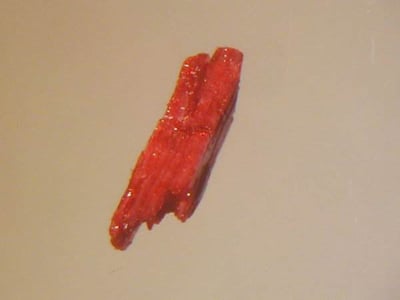
Getchellite is a rare sulfide of arsenic and antimony, AsSbS3, that was discovered by B. G. Weissberg of the New Zealand Department of Scientific and Industrial Research in 1963, and approved as a new species by the International Mineralogical Association in 1965. Many metal sulfides are grey to black, but a few are brightly colored. Orpiment is yellow to brownish gold, cinnabar is deep red and getchellite is a bright orange red.
Market Value Factors
Pricing varies for every rock and mineral, so use these universal factors to gauge Getchellite before comparing listings or appraisals.
Size & Weight
Larger, intact specimens usually command higher prices.
Rarity & Demand
Scarce material or popular varieties sell at a premium.
Condition & Finish
Chips, repairs, and heavy wear lower value; clean prep helps.
Treatment & Provenance
Untreated specimens with documented locality are prized.
Getchellite Localities Map
See where Getchellite is found with a localities map, collecting zones, and geology context. Generate a sample map preview below.
Key Characteristics
Composition of Getchellite
Each of the semimetal atoms, arsenic and antimony, is bonded to three sulfur atoms to form a trigonal pyramid characteristic of elements in group V of the periodic table. These (As,Sb)S3 pyramids form 8-membered (As,Sb)8S8 rings which in turn combine to form sheets parallel to (001), with each sulfur atom bonded to two semimetal atoms. The occupancy of the metal sites is disordered, and within the sheets the 8-membered rings are orientated normal to the plane of the sheet. The sheet structure is responsible for the cleavage and twin planes of getchellite Unit cell a = 11.949 Å; b = 9.028 Å; c = 10.130 Å; β= 116.15°; V = 980.9 Å; Z = 8. Space group P21/a.
More Images

Quick Facts
Physical Properties
- Color
- Dark blood red
- Hardness (Mohs)
- 1.5 - 2
- Density
- 3.98 g/cm³
- Streak
- Orange-red
Chemical Properties
- Chemical Formula
- AsSbS3
- Elements
- As, S, Sb
Identify Getchellite Instantly
- Snap a photo, get instant results
- 6,700+ rocks, minerals & crystals
- Discover collecting spots near you
Getchellite FAQs
How do I identify Getchellite?
Getchellite can be identified by its hardness of 1.5 - 2 on the Mohs scale, Dark blood red color. Look for these key characteristics when examining specimens.
What color is Getchellite?
Getchellite typically appears in Dark blood red. Color can vary depending on impurities and formation conditions.
How hard is Getchellite?
Getchellite has a hardness of 1.5 - 2 on the Mohs scale. This makes it a soft mineral that can be scratched easily.
What is the composition of getchellite of Getchellite?
Each of the semimetal atoms, arsenic and antimony, is bonded to three sulfur atoms to form a trigonal pyramid characteristic of elements in group V of the periodic table. These (As,Sb)S3 pyramids form 8-membered (As,Sb)8S8 rings which in turn combine to form sheets parallel to (001), with each sulfur atom bonded to two semimetal atoms. The occupancy of the metal sites is disordered, and within the sheets the 8-membered rings are orientated normal to the plane of the sheet. The sheet structure is responsible for the cleavage and twin planes of getchellite Unit cell a = 11.949 Å; b = 9.028 Å; c = 10.130 Å; β= 116.15°; V = 980.9 Å; Z = 8. Space group P21/a.

%252FAbenakiite-(ce)-01.jpg&size=small)

