Eudialyte
A variety of Eudialyte group

What is Eudialyte?
Eudialyte can be found in pink, red, brown, violet, and green varieties. They are often carved into spheres and usually accompanied by black and white minerals that create a stark contrast in jewelry pieces. Eudialyte is named after the Greek word meaning 'easily dissolved' as these minerals quickly dissolve in acidic solutions. It is primarily mined in Russia.
Uses & Applications
Eudialyte is used as a minor ore of zirconium and occasionally as a gemstone. However, these applications are not common due to this mineral’s rarity and tiny specimens. Eudialyte specimens are often kept for mineral collections.
Healing Properties
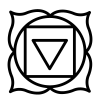
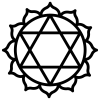
Eudialyte is a stone that works on the Heart and Root chakras to enhance intimate relationships. Often referred to as the stone of the heartland, it connects the energies of the two chakras bringing harmony to physical and emotional love. It is also helpful in matters of personal goals and business opportunities. It can be especially helpful during life changes. Use the stone when meditating or sleeping to gain insight into current and past relationships.
Optical Properties
- Refractive Index
- 1.591-1.633
- Birefringence
- 0.003-0.010
- Pleochroism
- Weak
- Optical Character
- Biaxial positive
Market Value Factors
Pricing varies for every rock and mineral, so use these universal factors to gauge Eudialyte before comparing listings or appraisals.
Size & Weight
Larger, intact specimens usually command higher prices.
Rarity & Demand
Scarce material or popular varieties sell at a premium.
Condition & Finish
Chips, repairs, and heavy wear lower value; clean prep helps.
Treatment & Provenance
Untreated specimens with documented locality are prized.
Eudialyte Localities Map
See where Eudialyte is found with a localities map, collecting zones, and geology context. Generate a sample map preview below.
Associated Chakras
Health & Safety Information
- ⚠️Eudialyte is toxic due to its Radioactivity.
- ⚠️Eudialyte is slightly radioactive because of containing small amounts of uranium. There is no health risks from wearing or handling pieces under 5 carats (1 gram) but holding a eudialyte sphere of 5,000 carats (1 kg) would exceed the safe limit.
- ⚠️Eudialyte contains trace amounts of uranium, making it slightly radioactive. Pieces under 5 carats pose no health risk, but larger specimens (1 kg) may exceed safe limits. When cutting or polishing eudialyte, wear gloves and a mask to avoid skin and lung exposure to its dust. Wash your hands thoroughly afterward. Store it in a sealed container away from children and pets.
More Images

Quick Facts
Physical Properties
- Color
- Variable, carmine-red, orange-red, orange, pink, cherry-red, brownish-red, yellowish-brown, brown, yellow, violet, green
- Hardness (Mohs)
- 5 - 6
- Density
- 2.74 - 3.1 g/cm³
- Streak
- White to pale pink
- Luster
- Vitreous, Dull
- Crystal System
- Trigonal
Chemical Properties
- Chemical Formula
- Na15Ca6Fe3Zr3Si(Si25O73)(O,OH,H2O)3(Cl,OH)2
- Elements
- Ca, Cl, Fe, H, I, Na, O, Si, V, Zr
Also Known As
Identify Eudialyte Instantly
- Snap a photo, get instant results
- 6,700+ rocks, minerals & crystals
- Discover collecting spots near you
Eudialyte FAQs
How do I identify Eudialyte?
Eudialyte can be identified by its hardness of 5 - 6 on the Mohs scale, Variable color, Vitreous, Dull luster, Trigonal crystal system. Look for these key characteristics when examining specimens.
What color is Eudialyte?
Eudialyte typically appears in Variable, carmine-red, orange-red, orange, pink, cherry-red, brownish-red, yellowish-brown, brown, yellow, violet, green. Color can vary depending on impurities and formation conditions.
How hard is Eudialyte?
Eudialyte has a hardness of 5 - 6 on the Mohs scale. This gives it moderate hardness.

