Elbaite
A variety of Tourmaline Group
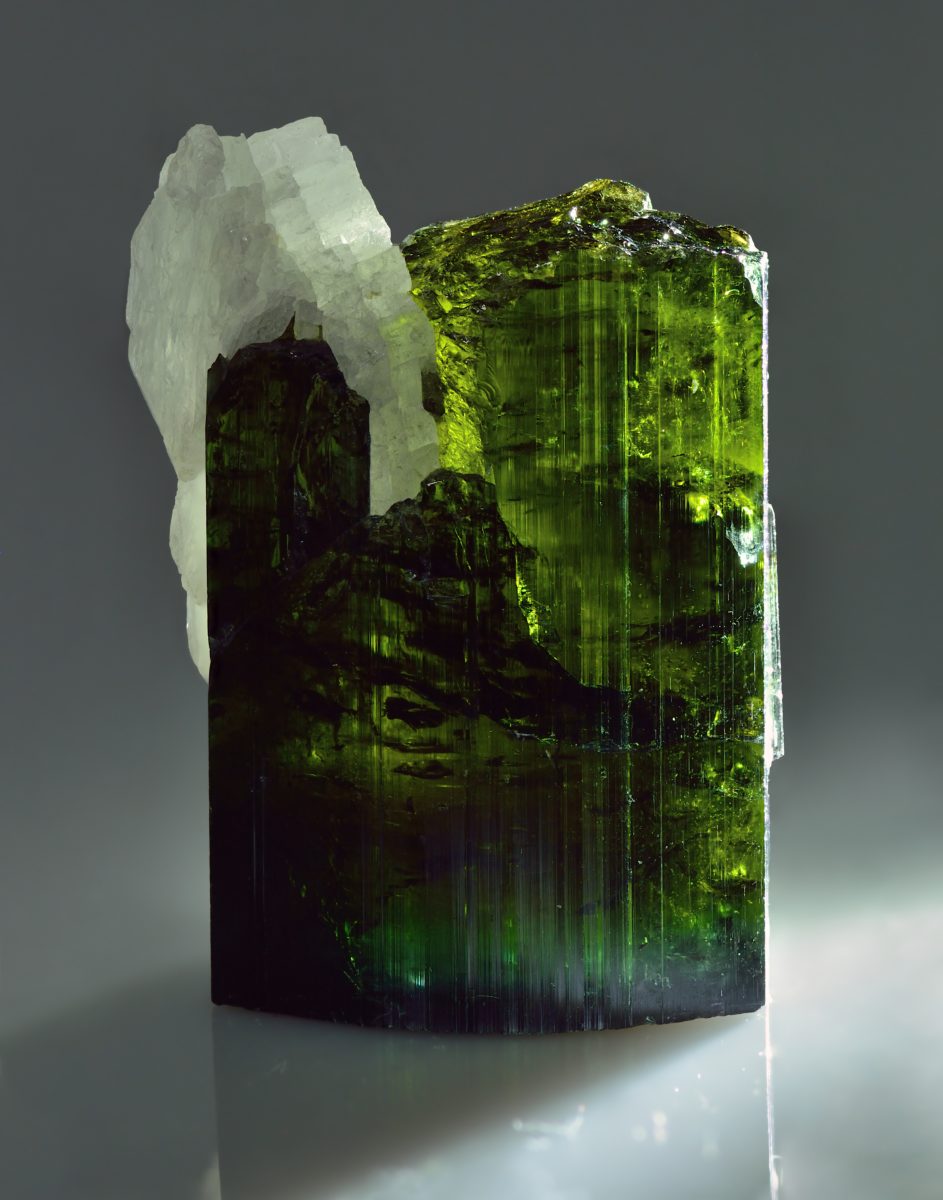
What is Elbaite?
Elbaite is an incredibly captivating gem that can present itself in almost any color of the rainbow. Its clarity and consistency make it one of the most desirable minerals for collectors. Demand for this darling gem has skyrocketed, with some varieties costing upwards of $15,000 USD per carat!
Uses & Applications
The rare beauty of elbaite makes it a popular gemstone and collector’s mineral. All the colors (colorless, blue, green, and pink) of elbaite are used in jewelry and are cut in all forms and styles. As a collector’s mineral, it is one of the most prized minerals in the world.
Optical Properties
- Refractive Index
- 1.614-1.666
- Birefringence
- 0.014-0.032
- Pleochroism
- Strong
- Optical Character
- Uniaxial negative
- Dispersion
- 0.017
Discover Values
Market Value Factors
Pricing varies for every rock and mineral, so use these universal factors to gauge Elbaite before comparing listings or appraisals.
Size & Weight
Larger, intact specimens usually command higher prices.
Rarity & Demand
Scarce material or popular varieties sell at a premium.
Condition & Finish
Chips, repairs, and heavy wear lower value; clean prep helps.
Treatment & Provenance
Untreated specimens with documented locality are prized.
Elbaite Localities Map
See where Elbaite is found with a localities map, collecting zones, and geology context. Generate a sample map preview below.
The Meaning
As the most common member of the tourmaline family, elbaite has different meanings across cultures. In England, it was thought to be a boost to creatives making art, architecture, and plays. In Africa, it was used to awaken those under the "dream of illusion." Modern-day Native Americans keep chunks of the crystal to protect against all evils. Elbaite has even been referenced as the philosopher's stone due to its high variety of effects.
Key Characteristics
Rock Types of Elbaite
Colorless: achroite variety (from the Greek "άχρωμος" meaning "colorless") Red or pinkish-red: rubellite variety (from ruby) Light blue to bluish green: Brazilian indicolite variety (from indigo) Green: Brazilian verdelite variety (from emerald) Watermelon tourmaline is a zoned variety with a reddish center surrounded by a green outer zone resembling watermelon rind, evident in cross section slices of prisms, often displaying curved sides.
Formation of Elbaite
Elbaite forms in igneous and metamorphic rocks and veins in association with lepidolite, microcline, and spodumene in granite pegmatites; with andalusite and biotite in schist; and with molybdenite and cassiterite in massive hydrothermal replacement deposits.
More Images


Quick Facts
Physical Properties
- Color
- Green, red to pink, blue, orange, yellow, colourless
- Hardness (Mohs)
- 7.5
- Density
- 3.069 g/cm³
- Streak
- White
- Luster
- Vitreous, Resinous
- Crystal System
- Trigonal
Chemical Properties
- Chemical Formula
- Na(Li1.5Al1.5)Al6(Si6O18)(BO3)3(OH)3(OH)
- Elements
- Al, B, H, Li, Na, O, Si
Also Known As
Identify Elbaite Instantly
- Snap a photo, get instant results
- 6,700+ rocks, minerals & crystals
- Discover collecting spots near you
Elbaite FAQs
How do I identify Elbaite?
Elbaite can be identified by its hardness of 7.5 on the Mohs scale, Green color, Vitreous, Resinous luster, Trigonal crystal system. Look for these key characteristics when examining specimens.
What color is Elbaite?
Elbaite typically appears in Green, red to pink, blue, orange, yellow, colourless. Color can vary depending on impurities and formation conditions.
How hard is Elbaite?
Elbaite has a hardness of 7.5 on the Mohs scale. This makes it a relatively hard mineral suitable for jewelry.
What is the rock types of elbaite of Elbaite?
Colorless: achroite variety (from the Greek "άχρωμος" meaning "colorless") Red or pinkish-red: rubellite variety (from ruby) Light blue to bluish green: Brazilian indicolite variety (from indigo) Green: Brazilian verdelite variety (from emerald) Watermelon tourmaline is a zoned variety with a reddish center surrounded by a green outer zone resembling watermelon rind, evident in cross section slices of prisms, often displaying curved sides.
What is the formation of elbaite of Elbaite?
Elbaite forms in igneous and metamorphic rocks and veins in association with lepidolite, microcline, and spodumene in granite pegmatites; with andalusite and biotite in schist; and with molybdenite and cassiterite in massive hydrothermal replacement deposits.
