Cymrite
A variety of Minerals
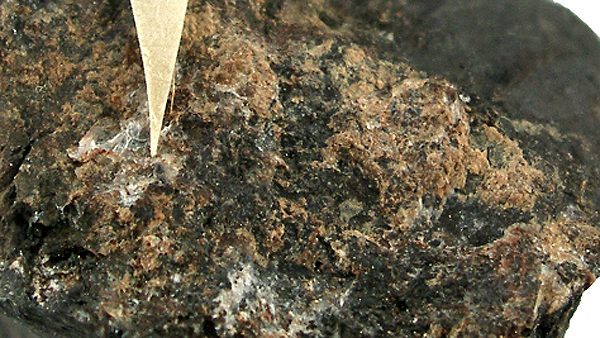
What is Cymrite?
Cymrite is a silicate mineral with the chemical formula BaAl2Si2(O,OH)8·H2O. The mineral is named for Cymru, which is the Welsh word for Wales. Cymrite, with perfect cleavage and a monoclinic crystalline system, falls in the silicate group. Silicates are formed of Silicon and Oxygen bonding together to form tetrahedra. The symmetry of Cymrite is classified as having a mirror plane. It has a moderate relief, meaning the contrast between the mineral and the epoxy of a thin section makes cymrite easily visible. The birefringence of the mineral is 0.01. Cymrite, being monoclinic is anisotropic with two optic axes.
Market Value Factors
Pricing varies for every rock and mineral, so use these universal factors to gauge Cymrite before comparing listings or appraisals.
Size & Weight
Larger, intact specimens usually command higher prices.
Rarity & Demand
Scarce material or popular varieties sell at a premium.
Condition & Finish
Chips, repairs, and heavy wear lower value; clean prep helps.
Treatment & Provenance
Untreated specimens with documented locality are prized.
Cymrite Localities Map
See where Cymrite is found with a localities map, collecting zones, and geology context. Generate a sample map preview below.
Key Characteristics
Formation of Cymrite
Cymrite was discovered in Wales but is found in other areas throughout the United States, Africa, Greece and other parts of Europe. It occurs in generally high temperature-pressure areas such as the hydrothermal manganese silicate ore that makes up the Benalt Mine in Wales and in manganese rock that has undergone high-pressure metamorphism found in Greece. It is important to geologists because of its limited occurrence, when cymrite is present on a rock it indicates that the rock, at some point, must have experienced high pressure and temperature.
Quick Facts
Physical Properties
- Color
- Colourless, green, brown
- Hardness (Mohs)
- 2 - 3
- Streak
- White
Chemical Properties
- Chemical Formula
- BaAl2Si2(O,OH)8 · H2O
- Elements
- Al, Ba, H, O, Si
Identify Cymrite Instantly
- Snap a photo, get instant results
- 6,700+ rocks, minerals & crystals
- Discover collecting spots near you
Cymrite FAQs
How do I identify Cymrite?
Cymrite can be identified by its hardness of 2 - 3 on the Mohs scale, Colourless color. Look for these key characteristics when examining specimens.
What color is Cymrite?
Cymrite typically appears in Colourless, green, brown. Color can vary depending on impurities and formation conditions.
How hard is Cymrite?
Cymrite has a hardness of 2 - 3 on the Mohs scale. This makes it a soft mineral that can be scratched easily.
What is the formation of cymrite of Cymrite?
Cymrite was discovered in Wales but is found in other areas throughout the United States, Africa, Greece and other parts of Europe. It occurs in generally high temperature-pressure areas such as the hydrothermal manganese silicate ore that makes up the Benalt Mine in Wales and in manganese rock that has undergone high-pressure metamorphism found in Greece. It is important to geologists because of its limited occurrence, when cymrite is present on a rock it indicates that the rock, at some point, must have experienced high pressure and temperature.

%252FAbenakiite-(ce)-01.jpg&size=small)

