Crocoite
A variety of Minerals
What is Crocoite?
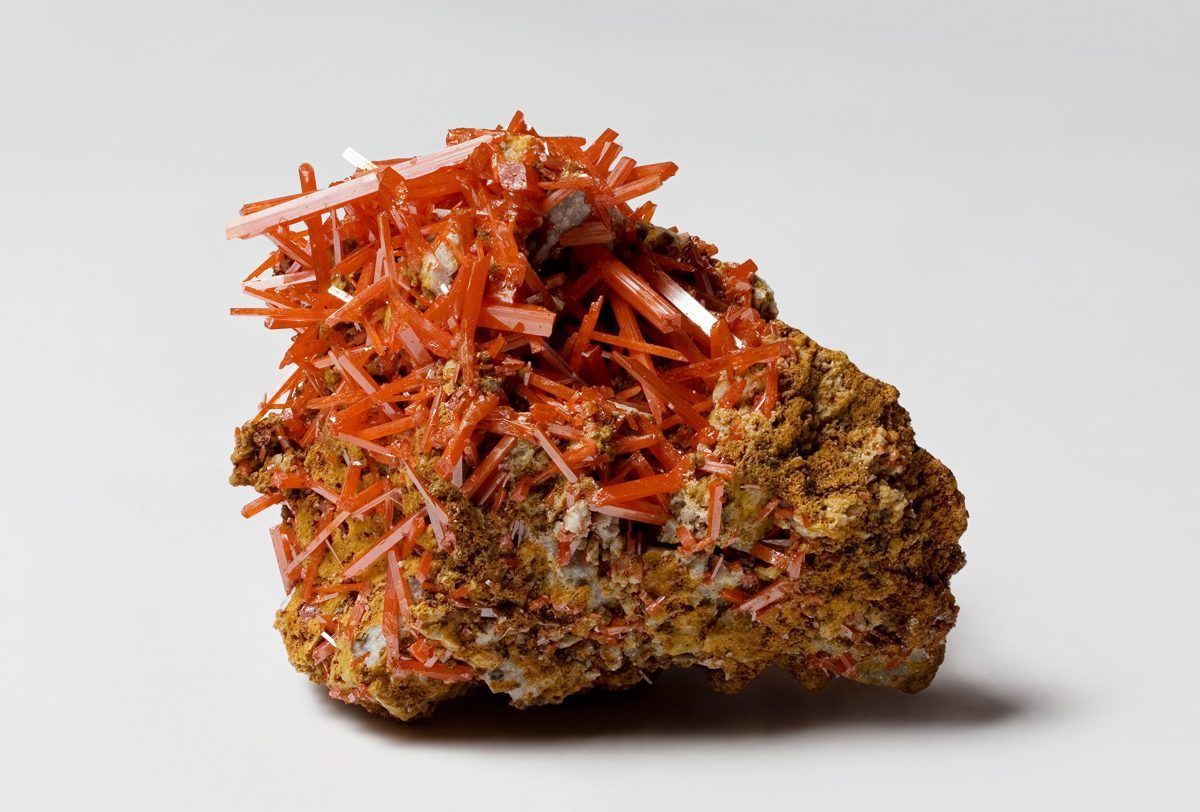
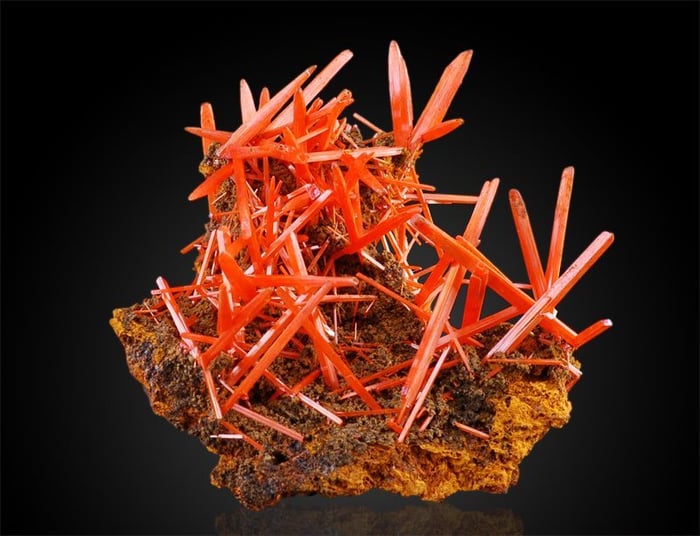
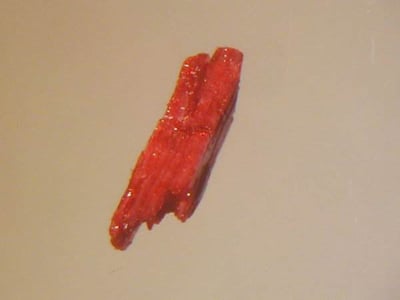
Crocoite is a highly-sought but rare mineral, prized for its beautiful deep orange-red color. It once was a main ore of Chromium, but now it's rarely used for that purpose. This eye-catching mineral is, unfortunately, too fragile to be used for jewelry, but it's still prized by mineral collectors. It is toxic.
Etymology & Origins
It was discovered at the Berezovskoe Au Deposit (Berezovsk Mines) near Ekaterinburg in the Urals in 1766; and named crocoise by F. S. Beudant in 1832, from the Greek κρόκος (krokos), saffron, in allusion to its color, a name first altered to crocoisite and afterwards to crocoite. In the type locality the crystals are found in gold-bearing quartz-veins traversing granite or gneiss and associated with crocoite are quartz, embreyite, phoenicochroite and vauquelinite. Phoenicochroite is a basic lead chromate, Pb2CrO5 with dark red crystals, and vauquelinite a lead and copper phosphate-chromate, Pb2CuCrO4PO4OH, with brown or green monoclinic crystals. Vauquelinite was named after Louis Nicolas Vauquelin, who in 1797 discovered (simultaneously with and independently of M. H. Klaproth) the element chromium in crocoite.
Uses & Applications
Crocoite was once used as an ore of chromium, but is now so rare that this is not commercially viable. Instead, specimens from Tasmania and Russia, the two main sources, are highly desired by collectors.
Healing Properties
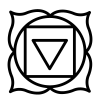
Crocoite is said to have a high frequency that will energize the whole body. Its positive action stimulates creativity and restores passion. It is often kept in the bedroom to improve sexual relationships, improve vitality, and allow the user to see the joy in everyday events. It connects the Base and Heart chakras to create a strong spiritual bond that promotes a sense of love and understanding.
Optical Properties
- Refractive Index
- 2.31-2.66
- Birefringence
- 0.35
- Pleochroism
- Distinctly trichroic
- Optical Character
- Biaxial positive
Market Value Factors
Pricing varies for every rock and mineral, so use these universal factors to gauge Crocoite before comparing listings or appraisals.
Size & Weight
Larger, intact specimens usually command higher prices.
Rarity & Demand
Scarce material or popular varieties sell at a premium.
Condition & Finish
Chips, repairs, and heavy wear lower value; clean prep helps.
Treatment & Provenance
Untreated specimens with documented locality are prized.
Crocoite Localities Map
See where Crocoite is found with a localities map, collecting zones, and geology context. Generate a sample map preview below.
The Meaning
Crocoite is a birthstone for the sign of Aries. It was declared the official state mineral of Tasmania, Australia in 2000. It was used as a paint pigment to decorate the walls of Nefertari's tomb in Thebes in Egypt. Furthermore, it was used to to paint murals in the church of St. Gallus in northern Bohemia in today's Czech Republic
Associated Chakras


Health & Safety Information
- ⚠️Crocoite dust is toxic because it contains heavy metals Hexavalent Chromium, Lead.
- ⚠️Hexavalent_Chromium, Lead
- ⚠️It's advisable to handle crocoite carefully to avoid generating dust and wash hands thoroughly afterward. When cutting or polishing crocoite, wear a dust mask to prevent inhaling heavy metal particles. Store crocoite in a sealed container in a well-ventilated area, away from children and pets. For those involved in crystal healing, never put it in your mouth.
More Images


Quick Facts
Physical Properties
- Color
- Orange, red, yellow, orange-red in transmitted light
- Hardness (Mohs)
- 2.5 - 3
- Density
- 5.97 g/cm³
- Streak
- Yellow-orange
- Luster
- Resinous, Waxy, Sub-vitreous, Sub-adamantine
- Crystal System
- Monoclinic
Chemical Properties
- Chemical Formula
- PbCr6+O4
- Elements
- Cr, O, Pb
Also Known As
Identify Crocoite Instantly
- Snap a photo, get instant results
- 6,700+ rocks, minerals & crystals
- Discover collecting spots near you
Crocoite FAQs
How do I identify Crocoite?
Crocoite can be identified by its hardness of 2.5 - 3 on the Mohs scale, Orange color, Resinous, Waxy, Sub-vitreous, Sub-adamantine luster, Monoclinic crystal system. Look for these key characteristics when examining specimens.
What color is Crocoite?
Crocoite typically appears in Orange, red, yellow, orange-red in transmitted light. Color can vary depending on impurities and formation conditions.
How hard is Crocoite?
Crocoite has a hardness of 2.5 - 3 on the Mohs scale. This makes it a soft mineral that can be scratched easily.

%252FAbenakiite-(ce)-01.jpg&size=small)

