Charoite
A variety of Minerals

What is Charoite?
Charoite is a rare mineral only found in a part of Siberia, Russia. The stone’s lilac, lavender, or violet colors are stunning and have unique swirling patterns that make for beautiful gemstones. Traditional gem makers can make cabochons from the material, while carvers can make decorative objects as large as vases or bookends.
Uses & Applications
Charoite is highly sought-after as a gemstone. Commercially, most of this mineral is used in Russia's domestic jewelry industry, since that country is its only source. In other countries, you can find this mineral used in beads, cabochons, and tumbled stones. This stone is also sculpted into items such as vases, boxes, and decorative tiles.
Healing Properties
Charoite has associations with transformation and change; it is used by some as a support crystal when away from home or separated from loved ones. The energies that are thought to emit from this crystal strengthen the body and emotions whilst offering protection from negative energies and providing balance.This mineral is also said to encourage visions from past lives.
Optical Properties
- Refractive Index
- 1.545-1.560
- Birefringence
- 0.009
- Pleochroism
- None
- Optical Character
- Biaxial positive
Discover Values
This stone excels in beauty.
Market Value Factors
Pricing varies for every rock and mineral, so use these universal factors to gauge Charoite before comparing listings or appraisals.
Size & Weight
Larger, intact specimens usually command higher prices.
Rarity & Demand
Scarce material or popular varieties sell at a premium.
Condition & Finish
Chips, repairs, and heavy wear lower value; clean prep helps.
Treatment & Provenance
Untreated specimens with documented locality are prized.
Charoite Localities Map
See where Charoite is found with a localities map, collecting zones, and geology context. Generate a sample map preview below.
Associated Chakras
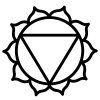
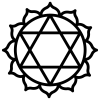
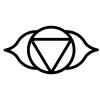
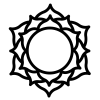
More Images


Quick Facts
Physical Properties
- Color
- Violet to deep lilac
- Hardness (Mohs)
- 5 - 6
- Density
- 2.77 g/cm³
- Streak
- White
- Luster
- Vitreous, Silky
- Crystal System
- Monoclinic
Chemical Properties
- Chemical Formula
- (K,Sr)15-16(Ca,Na)32[Si6O11(O,OH)6]2[Si12O18(O,OH)12]2[Si17O25(O,OH)18]2(OH,F)4 · ~3H2O
- Elements
- Ca, F, H, K, Na, O, Si, Sr
Also Known As
Identify Charoite Instantly
- Snap a photo, get instant results
- 6,700+ rocks, minerals & crystals
- Discover collecting spots near you
Charoite FAQs
How do I identify Charoite?
Charoite can be identified by its hardness of 5 - 6 on the Mohs scale, Violet to deep lilac color, Vitreous, Silky luster, Monoclinic crystal system. Look for these key characteristics when examining specimens.
What color is Charoite?
Charoite typically appears in Violet to deep lilac. Color can vary depending on impurities and formation conditions.
How hard is Charoite?
Charoite has a hardness of 5 - 6 on the Mohs scale. This gives it moderate hardness.

%252FAbenakiite-(ce)-01.jpg&size=small)

