Carnelian

What is Carnelian?
Carnelian is a translucent, orange to red variety of chalcedony, a cryptocrystalline form of silica. Its color is due to the presence of iron oxide impurities. It is a relatively hard and durable gemstone, often used in jewelry and carvings.
Optical Properties
- Refractive Index
- 1.544-1.553
- Birefringence
- None
- Pleochroism
- None
- Optical Character
- Isotropic
- Dispersion
- Low
Market Value Factors
Pricing varies for every rock and mineral, so use these universal factors to gauge Carnelian before comparing listings or appraisals.
Size & Weight
Larger, intact specimens usually command higher prices.
Rarity & Demand
Scarce material or popular varieties sell at a premium.
Condition & Finish
Chips, repairs, and heavy wear lower value; clean prep helps.
Treatment & Provenance
Untreated specimens with documented locality are prized.
Carnelian Localities Map
See where Carnelian is found with a localities map, collecting zones, and geology context. Generate a sample map preview below.
More Images

Quick Facts
Physical Properties
- Color
- Orange, Red, Brownish-red
- Hardness (Mohs)
- 6.5 to 7
- Density
- 2.58 to 2.64 g/cm³
- Streak
- White
Chemical Properties
- Chemical Formula
- SiO2
- Elements
- Silicon, Oxygen, Iron
Also Known As
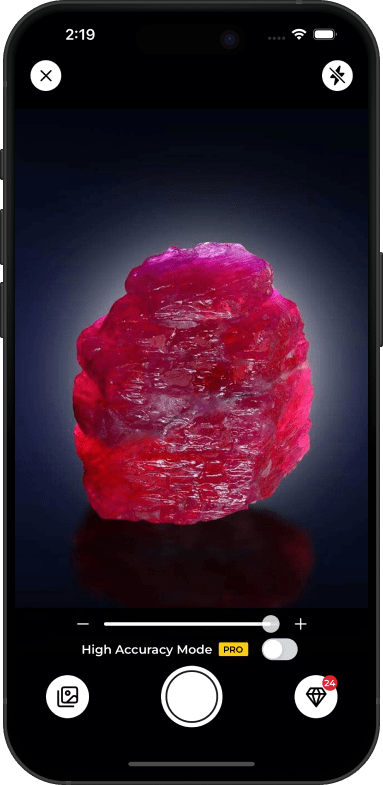
Identify Carnelian Instantly
- Snap a photo, get instant results
- 6,700+ rocks, minerals & crystals
- Discover collecting spots near you
Carnelian FAQs
How do I identify Carnelian?
Carnelian can be identified by its hardness of 6.5 to 7 on the Mohs scale, Orange color. Look for these key characteristics when examining specimens.
What color is Carnelian?
Carnelian typically appears in Orange, Red, Brownish-red. Color can vary depending on impurities and formation conditions.
How hard is Carnelian?
Carnelian has a hardness of 6.5 to 7 on the Mohs scale. This gives it moderate hardness.