Boleite
A variety of Minerals

What is Boleite?
Holding a gem of boleite in your hands is a treat that very few get to experience. This beautiful mineral contains such precious elements as silver but is displayed in an unforgettable blue package. In some collector circuits, it is considered the rarest of all cut gemstones, and availability is quite scarce on traders' markets.
Uses & Applications
Boleite is a source of copper in some areas, though more common sources are typically preferred. Copper is used in a wide variety of applications, from electrical equipment to coins to sugar detection. It is also a minor source of lead and silver. Its primary use is among collectors due to its attractive appearance.
Optical Properties
- Refractive Index
- 2.05
- Birefringence
- 0.01
- Optical Character
- Uniaxial negative
- Dispersion
- 0.071
Market Value Factors
Pricing varies for every rock and mineral, so use these universal factors to gauge Boleite before comparing listings or appraisals.
Size & Weight
Larger, intact specimens usually command higher prices.
Rarity & Demand
Scarce material or popular varieties sell at a premium.
Condition & Finish
Chips, repairs, and heavy wear lower value; clean prep helps.
Treatment & Provenance
Untreated specimens with documented locality are prized.
Boleite Localities Map
See where Boleite is found with a localities map, collecting zones, and geology context. Generate a sample map preview below.
Key Characteristics
Characteristics of Boleite
The external property of a boleite crystal structure indicates its cubic structure. It is classified under the isometric crystal class. Boleite has a perfect cleavage in the [001] direction, and has a very dark glossy blue color with a light greenish-blue color streak. Twinning is best shown in this mineral by notches along the interpenetrated angles, which results in a crystal habit of pseudocubic penetration twinning along three different angles perpendicular to one another. Boleite has cubes over half an inch on each side, which consist of pseudo-octahedral tetragonal dipyramids.
Formation of Boleite
Boleite was first collected as a very minor ore of silver, copper and lead at Boleo, Mexico. Boleite was named after its place of discovery, El Boleo mine, on the Baja Peninsula, near Santa Rosalia, Mexico. Minerals associated with boleite include pseudoboleite, cumengeite, atacamite, anglesite, cerussite, phosgenite and gypsum at the type locality in Boleo, Mexico. In the Mammoth-St. Anthony mine of Arizona associated minerals include pseudoboleite, anglesite, cerussite, atacamite, paratacamite, leadhillite, paralaurionite, caledonite, phosgenite, matlockite and bideauxite.
Health & Safety Information
- ⚠️Boleite dust is toxic because it contains heavy metals Copper, Lead.
- ⚠️Copper, Lead
- ⚠️It's advisable to handle boleite carefully to avoid generating dust and wash hands thoroughly afterward. When cutting or polishing boleite, wear a dust mask to prevent inhaling heavy metal particles. Store boleite in a sealed container in a well-ventilated area, away from children and pets. For those involved in crystal healing, never put it in your mouth.
More Images

Quick Facts
Physical Properties
- Color
- Deep prussian blue to indigo, bluish green in transmitted light
- Hardness (Mohs)
- 3 - 3.5
- Density
- 5.062 g/cm³
- Streak
- Blue, with greenish tint
- Luster
- Pearly, Vitreous
- Crystal System
- Isometric
Chemical Properties
- Chemical Formula
- KPb26Ag9Cu24(OH)48Cl62
- Elements
- Ag, Cl, Cu, H, K, O, Pb
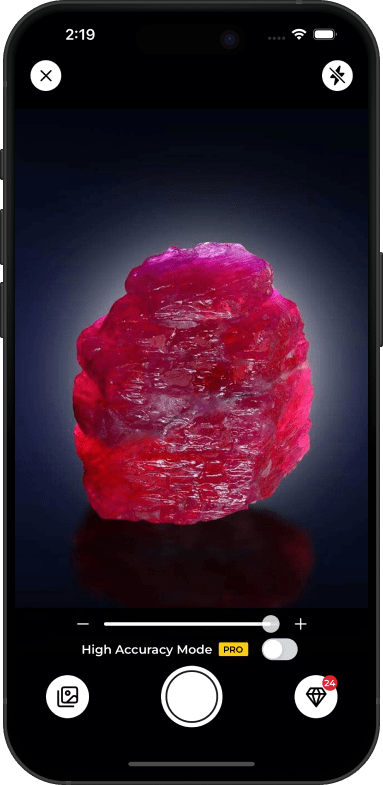
Identify Boleite Instantly
- Snap a photo, get instant results
- 6,700+ rocks, minerals & crystals
- Discover collecting spots near you
Boleite FAQs
How do I identify Boleite?
Boleite can be identified by its hardness of 3 - 3.5 on the Mohs scale, Deep prussian blue to indigo color, Pearly, Vitreous luster, Isometric crystal system. Look for these key characteristics when examining specimens.
What color is Boleite?
Boleite typically appears in Deep prussian blue to indigo, bluish green in transmitted light. Color can vary depending on impurities and formation conditions.
How hard is Boleite?
Boleite has a hardness of 3 - 3.5 on the Mohs scale. This makes it a soft mineral that can be scratched easily.
What is the characteristics of boleite of Boleite?
The external property of a boleite crystal structure indicates its cubic structure. It is classified under the isometric crystal class. Boleite has a perfect cleavage in the [001] direction, and has a very dark glossy blue color with a light greenish-blue color streak. Twinning is best shown in this mineral by notches along the interpenetrated angles, which results in a crystal habit of pseudocubic penetration twinning along three different angles perpendicular to one another. Boleite has cubes over half an inch on each side, which consist of pseudo-octahedral tetragonal dipyramids.
What is the formation of boleite of Boleite?
Boleite was first collected as a very minor ore of silver, copper and lead at Boleo, Mexico. Boleite was named after its place of discovery, El Boleo mine, on the Baja Peninsula, near Santa Rosalia, Mexico. Minerals associated with boleite include pseudoboleite, cumengeite, atacamite, anglesite, cerussite, phosgenite and gypsum at the type locality in Boleo, Mexico. In the Mammoth-St. Anthony mine of Arizona associated minerals include pseudoboleite, anglesite, cerussite, atacamite, paratacamite, leadhillite, paralaurionite, caledonite, phosgenite, matlockite and bideauxite.


%252FAbenakiite-(ce)-01.jpg&size=small)

