Bobfergusonite
A variety of Minerals
What is Bobfergusonite?
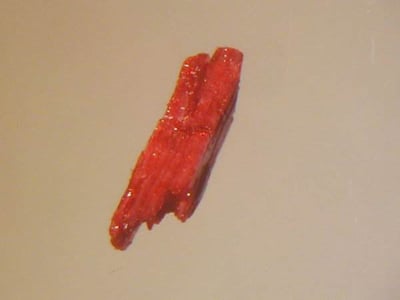
Bobfergusonite occurs as equant anhedral single crystals up to 1 cm (0.39 in) in size or as nodular aggregates of few crystals. The mineral varies in color from green-brown to red-brown. Thin fragments of bobfergusonite are transparent. Bobfergusonite has been found in association with alluaudite, apatite, beusite, fillowite, and triplite. Bobfergusonite is a primary mineral that occurs in the intermediate zone of manganese and fluorine enriched granitic pegmatites.
Market Value Factors
Pricing varies for every rock and mineral, so use these universal factors to gauge Bobfergusonite before comparing listings or appraisals.
Size & Weight
Larger, intact specimens usually command higher prices.
Rarity & Demand
Scarce material or popular varieties sell at a premium.
Condition & Finish
Chips, repairs, and heavy wear lower value; clean prep helps.
Treatment & Provenance
Untreated specimens with documented locality are prized.
Bobfergusonite Localities Map
See where Bobfergusonite is found with a localities map, collecting zones, and geology context. Generate a sample map preview below.
Key Characteristics
Composition of Bobfergusonite
Bobfergusonite has a layered crystal structure topologically identical to that of alluaudite and wyllieite but with differences in the ordering of metal cations. The two types of layer alternate along Y. One layer consists of chains of metal cation octahedra cross-linked by phosphate tetrahedra. Within the chains metal cations are ordered M–M in a similar fashion to wyllieite. However, the structure of bobfergusonite is distinct by the presence of Al and Fe ordering between chains. The other layer, identical to its wyllieite counterpart, consists of chains running parallel to X: one consisting of alternating, face-sharing sodium and manganese polyhedra and the other edge-sharing sodium polyhedra. These chains are not cross-linked but bind the other layers together.
Quick Facts
Physical Properties
- Color
- Green-brown to red-brown
- Hardness (Mohs)
- 4
- Density
- 3.57 g/cm³
- Streak
- Yellow-brown
Chemical Properties
- Chemical Formula
- Na2Mn5FeAl(PO4)6
- Elements
- Al, Fe, Mn, Na, O, P
Identify Bobfergusonite Instantly
- Snap a photo, get instant results
- 6,700+ rocks, minerals & crystals
- Discover collecting spots near you
Bobfergusonite FAQs
How do I identify Bobfergusonite?
Bobfergusonite can be identified by its hardness of 4 on the Mohs scale, Green-brown to red-brown color. Look for these key characteristics when examining specimens.
What color is Bobfergusonite?
Bobfergusonite typically appears in Green-brown to red-brown. Color can vary depending on impurities and formation conditions.
How hard is Bobfergusonite?
Bobfergusonite has a hardness of 4 on the Mohs scale. This gives it moderate hardness.
What is the composition of bobfergusonite of Bobfergusonite?
Bobfergusonite has a layered crystal structure topologically identical to that of alluaudite and wyllieite but with differences in the ordering of metal cations. The two types of layer alternate along Y. One layer consists of chains of metal cation octahedra cross-linked by phosphate tetrahedra. Within the chains metal cations are ordered M–M in a similar fashion to wyllieite. However, the structure of bobfergusonite is distinct by the presence of Al and Fe ordering between chains. The other layer, identical to its wyllieite counterpart, consists of chains running parallel to X: one consisting of alternating, face-sharing sodium and manganese polyhedra and the other edge-sharing sodium polyhedra. These chains are not cross-linked but bind the other layers together.

%252FAbenakiite-(ce)-01.jpg&size=small)

