Barite
Baryte
A variety of Baryte Group

What is Barite?
Barite is incredibly unique and can fool you if you're not careful. The glistening surface area makes it seem like a lightweight mineral, but it is heavy! It is so heavy that it has a similar weight to metallic minerals, although it has no metallic properties.
Etymology & Origins
The name baryte is derived from the Ancient Greek: βαρύς, romanized: barús, 'heavy'. The American spelling is barite. The International Mineralogical Association initially adopted "barite" as the official spelling, but recommended adopting the older "baryte" spelling later. This move was controversial and was notably ignored by American mineralogists.
Uses & Applications
Barite has a wide range of applications. By far, the most common industrial use of the mineral ore is in drilling, where it is used as a part of drilling fluids. It has a wide variety of commercial uses, such as medical imaging, plastics, paint, and golf balls.
Healing Properties
Barite is a detoxifying stone that helps one to let go of toxic patterns of behavior and other mental and emotional issues that are not serving the person's greatest good. It empowers one to move forward in their life and helps in issues of self-awareness and self-acceptance. When placed near the bed, it is said to help with dream interpretation and allow a person to attain higher consciousness in the spiritual realm.
Optical Properties
- Refractive Index
- 1.634-1.648
- Birefringence
- 0.010-0.018
- Pleochroism
- None
- Optical Character
- Biaxial positive
Discover Values
Market Value Factors
Pricing varies for every rock and mineral, so use these universal factors to gauge Barite before comparing listings or appraisals.
Size & Weight
Larger, intact specimens usually command higher prices.
Rarity & Demand
Scarce material or popular varieties sell at a premium.
Condition & Finish
Chips, repairs, and heavy wear lower value; clean prep helps.
Treatment & Provenance
Untreated specimens with documented locality are prized.
Barite Localities Map
See where Barite is found with a localities map, collecting zones, and geology context. Generate a sample map preview below.
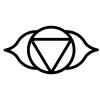
Associated Chakras

Health & Safety Information
- ⚠️Barite dust is toxic because it contains heavy metals Barium.
- ⚠️Barium
- ⚠️It's advisable to handle barite carefully to avoid generating dust and wash hands thoroughly afterward. When cutting or polishing barite, wear a dust mask to prevent inhaling heavy metal particles. Store barite in a sealed container in a well-ventilated area, away from children and pets. For those involved in crystal healing, never put it in your mouth.
More Images

Quick Facts
Physical Properties
- Color
- Colourless, white, yellow, brown, grey, blue
- Hardness (Mohs)
- 3
- Density
- 4.5 g/cm³
- Streak
- white
- Luster
- Pearly, Vitreous
- Crystal System
- Orthorhombic
Chemical Properties
- Chemical Formula
- BaSO4
- Elements
- Ba, O, S
Also Known As
Identify Barite Instantly
- Snap a photo, get instant results
- 6,700+ rocks, minerals & crystals
- Discover collecting spots near you
Barite FAQs
How do I identify Barite?
Barite can be identified by its hardness of 3 on the Mohs scale, Colourless color, Pearly, Vitreous luster, Orthorhombic crystal system. Look for these key characteristics when examining specimens.
What color is Barite?
Barite typically appears in Colourless, white, yellow, brown, grey, blue. Color can vary depending on impurities and formation conditions.
How hard is Barite?
Barite has a hardness of 3 on the Mohs scale. This makes it a soft mineral that can be scratched easily.

