Apricot Agate
A variety of Chalcedony
What is Apricot Agate?
Apricot Agate is a semi-precious stone noted for its apricot color and subtle white, cream, or pale pink bands. Agate is a variegated form of Chalcedony, which is a fibrous form of Quartz. When cut and polished, beautiful striations are exposed. The beauty of these stones is often enhanced by various treatments to brighten or change their color, as is the case with apricot Agate which is commonly developed from naturally-grey agates.
Optical Properties
- Refractive Index
- 1.530-1.543
- Birefringence
- 0.003-0.009
- Pleochroism
- None
- Optical Character
- Biaxial positive
- Dispersion
- 0.013
Discover Values
Market Value Factors
Pricing varies for every rock and mineral, so use these universal factors to gauge Apricot Agate before comparing listings or appraisals.
Size & Weight
Larger, intact specimens usually command higher prices.
Rarity & Demand
Scarce material or popular varieties sell at a premium.
Condition & Finish
Chips, repairs, and heavy wear lower value; clean prep helps.
Treatment & Provenance
Untreated specimens with documented locality are prized.
Apricot Agate Localities Map
See where Apricot Agate is found with a localities map, collecting zones, and geology context. Generate a sample map preview below.
Health & Safety Information
- ⚠️Apricot Agate in powdered form can be toxic due to its Crystalline Silica content.
- ⚠️Quartz, silica, crystalline silica and flint are non-toxic materials, but very fine dust containing quartz, known as respirable crystalline silicon (RCS), can cause serious and fatal lung disease. Lapidaries should exercise caution when cutting silica.
- ⚠️Apricot Agate is typically non-toxic unless it's in powder form. Long-term exposure to finely ground powder may lead to silicosis. Therefore, when cutting or polishing apricot Agate, be sure to wear a dust mask to avoid inhaling its dust.
Quick Facts
Physical Properties
- Color
- Pinkish-orange, white, red
- Hardness (Mohs)
- 6.5 - 7
- Density
- 2.55 - 2.7 g/cm³
- Streak
- White
- Luster
- Waxy, Vitreous
- Crystal System
- Trigonal
Chemical Properties
- Chemical Formula
- SiO2
- Elements
- Si, O
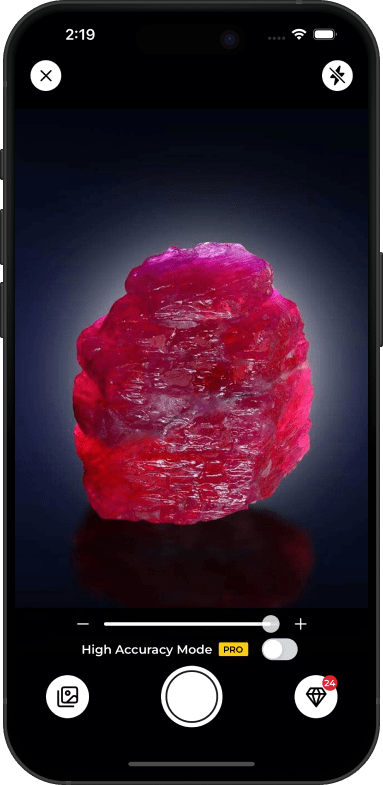
Identify Apricot Agate Instantly
- Snap a photo, get instant results
- 6,700+ rocks, minerals & crystals
- Discover collecting spots near you
Apricot Agate FAQs
How do I identify Apricot Agate?
Apricot Agate can be identified by its hardness of 6.5 - 7 on the Mohs scale, Pinkish-orange color, Waxy, Vitreous luster, Trigonal crystal system. Look for these key characteristics when examining specimens.
What color is Apricot Agate?
Apricot Agate typically appears in Pinkish-orange, white, red. Color can vary depending on impurities and formation conditions.
How hard is Apricot Agate?
Apricot Agate has a hardness of 6.5 - 7 on the Mohs scale. This gives it moderate hardness.