Amber

What is Amber?
Amber is a fossilized or semi-fossilized resin generated from the trees. Though ambers could date from hundreds of million years ago while some copal only has a history of a few thousands of years, they share a very similar appearance. It is an important gemstone since antiquity. The ones with insects or other animals/plants preserved would have a higher value.
Uses & Applications
Amber has been used in jewelry since the Neolithic period and it is still popular today. The fossilized resin is also used to decorate walls, the most famous example of which was in Russia's Catherina Palace. The resin is also used to create decorations found in homes, spas, and restaurants. Despite movies like Jurassic Park, DNA has never been recovered from within fossilized amber.
Healing Properties
Renowned as a healing talisman and good luck charm, amber is reputed to encourage calmness, stability, and nourishment. It is related to the sacral chakra. The best way to use it is close to the skin, in the form of jewelry, but also within feng shui practice.
Optical Properties
- Refractive Index
- 1.539-1.545
- Pleochroism
- None
- Optical Character
- Isotropic
Discover Values
This stone excels in popularity, cultural value, collection value.
Market Value Factors
Pricing varies for every rock and mineral, so use these universal factors to gauge Amber before comparing listings or appraisals.
Size & Weight
Larger, intact specimens usually command higher prices.
Rarity & Demand
Scarce material or popular varieties sell at a premium.
Condition & Finish
Chips, repairs, and heavy wear lower value; clean prep helps.
Treatment & Provenance
Untreated specimens with documented locality are prized.
Amber Localities Map
See where Amber is found with a localities map, collecting zones, and geology context. Generate a sample map preview below.
The Meaning
Known since ancient times, amber was mentioned in Homer's Odyssey, as well as in Plato's and Aristotle's writings. According to ancient Greeks, amber was created from the tears of Apollo's daughter, the God of sun and poetry. It was traditionally used as an amulet and talisman against evil. Amber was particularly favored by sailors who would burn it to protect themselves from evil spirits and sea monsters.
Associated Chakras
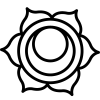
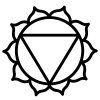
More Images


Quick Facts
Physical Properties
- Color
- Yellow-orange-brown, pale lemon yellow, red, brown, nearly black, rarely blue or green
- Hardness (Mohs)
- 2 - 2.5
- Density
- 1.05 - 1.15 g/cm³
- Streak
- White
- Luster
- Resinous
- Crystal System
- Amorphous
Chemical Properties
- Chemical Formula
- [C, H, O]
Also Known As
Identify Amber Instantly
- Snap a photo, get instant results
- 6,700+ rocks, minerals & crystals
- Discover collecting spots near you
Amber FAQs
How do I identify Amber?
Amber can be identified by its hardness of 2 - 2.5 on the Mohs scale, Yellow-orange-brown color, Resinous luster, Amorphous crystal system. Look for these key characteristics when examining specimens.
What color is Amber?
Amber typically appears in Yellow-orange-brown, pale lemon yellow, red, brown, nearly black, rarely blue or green. Color can vary depending on impurities and formation conditions.
How hard is Amber?
Amber has a hardness of 2 - 2.5 on the Mohs scale. This makes it a soft mineral that can be scratched easily.