Allophane
A variety of Minerals
What is Allophane?
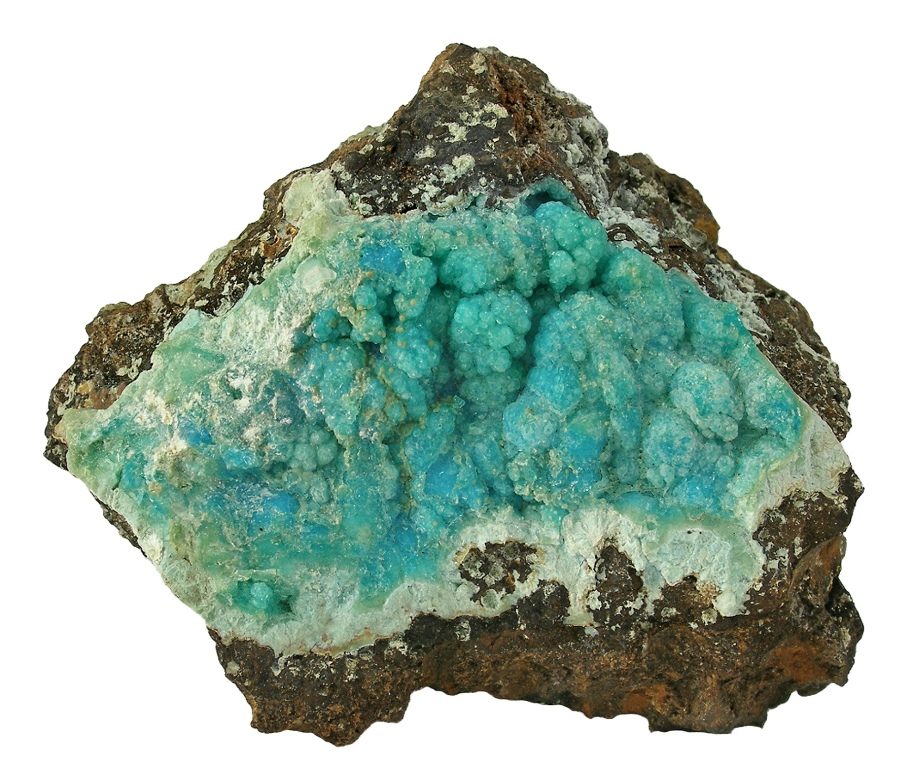
Allophane is an amorphous to poorly crystalline hydrous aluminium silicate clay mineraloid. Its chemical formula is Al2O3·(SiO2)1.3-2·(2.5-3)H2O. Since it has short-range atomic order, it is a mineraloid, rather than a mineral, and can be identified by its distinctive infrared spectrum and its X-ray diffraction pattern. It was first described in 1816 in Gräfenthal, Thuringia, Germany. Allophane is a weathering or hydrothermal alteration product of volcanic glass and feldspars and sometimes has a composition similar to kaolinite but generally has a molar ratio of Al:Si = 2. It typically forms under mildly acidic to neutral pH (5–7). Its structure has been debated, but it is similar to clay minerals and is composed of curved alumina octahedral and silica tetrahedral layers. Transmission electron micrographs show that it is generally made up of aggregates of hollow spherules ~3–5 nm in diameter. Allophane can alter to form halloysite under resilicating aqueous conditions and can alter to form gibbsite under desilicating conditions. A copper containing variety cupro-allophane has been reported. It forms waxy botryoidal to crusty masses with color varying from white through green, blue, yellow, to brown. It has a Mohs hardness of 3 and a specific gravity of 1.0. It was named from the Greek allos – "other" and phanos – "to appear", as it gave a deceptive reaction in the blowpipe flame in old mineralogical testing.
Market Value Factors
Pricing varies for every rock and mineral, so use these universal factors to gauge Allophane before comparing listings or appraisals.
Size & Weight
Larger, intact specimens usually command higher prices.
Rarity & Demand
Scarce material or popular varieties sell at a premium.
Condition & Finish
Chips, repairs, and heavy wear lower value; clean prep helps.
Treatment & Provenance
Untreated specimens with documented locality are prized.
Allophane Localities Map
See where Allophane is found with a localities map, collecting zones, and geology context. Generate a sample map preview below.
Quick Facts
Physical Properties
- Color
- White, pale blue to sky-blue, green, brown
- Hardness (Mohs)
- 3
- Streak
- White
Chemical Properties
- Chemical Formula
- (Al2O3)(SiO2)1.3-2 · 2.5-3H2O
- Elements
- Al, H, O, Si
Also Known As

Identify Allophane Instantly
- Snap a photo, get instant results
- 6,700+ rocks, minerals & crystals
- Discover collecting spots near you
Allophane FAQs
How do I identify Allophane?
Allophane can be identified by its hardness of 3 on the Mohs scale, White color. Look for these key characteristics when examining specimens.
What color is Allophane?
Allophane typically appears in White, pale blue to sky-blue, green, brown. Color can vary depending on impurities and formation conditions.
How hard is Allophane?
Allophane has a hardness of 3 on the Mohs scale. This makes it a soft mineral that can be scratched easily.


%252FAbenakiite-(ce)-01.jpg&size=small)

