Akimotoite
A variety of Minerals
What is Akimotoite?
Akimotoite is a rare silicate mineral ((Mg,Fe)SiO3) in the ilmenite group of minerals. It is polymorphous with pyroxene and with bridgmanite, a natural silicate perovskite that is the most abundant mineral in Earth's silicate mantle. Akimotoite has a vitreous luster, is colorless, and has a white or colorless streak. It crystallizes in the trigonal crystal system in space group R3. It is the silicon analogue of geikielite (MgTiO3).
Market Value Factors
Pricing varies for every rock and mineral, so use these universal factors to gauge Akimotoite before comparing listings or appraisals.
Size & Weight
Larger, intact specimens usually command higher prices.
Rarity & Demand
Scarce material or popular varieties sell at a premium.
Condition & Finish
Chips, repairs, and heavy wear lower value; clean prep helps.
Treatment & Provenance
Untreated specimens with documented locality are prized.
Akimotoite Localities Map
See where Akimotoite is found with a localities map, collecting zones, and geology context. Generate a sample map preview below.
Key Characteristics
Formation of Akimotoite
Akimotoite was found in the Tenham meteorites in Queensland, Australia. It is believed to have formed as the result of an extraterrestrial shock event. It is the silicon analogue of geikielite (MgTiO3). It was named after physicist Syun-iti Akimoto (also known as Shun'ichi Akimoto (秋本 俊一)) (1925–2004), University of Tokyo. It has also been reported from the Sixiangkou meteorite in the Gaogang District, Jiangsu Province, Taizhou Prefecture, China; the Zagami Martian meteorite, Katsina State, Nigeria and from the Umbarger meteorite, Randall County, Texas. Akimotoite is believed to be a significant mineral in the Earth's mantle at depths of 600–800 kilometres (370–500 mi) in cooler regions of the mantle such as where a subducted slab enters into the lower mantle. Akimotoite is elastically anisotropic and has been suggested as a cause of seismic anisotropy in the lower transition zone and uppermost lower mantle.
Composition of Akimotoite
The crystal structure is similar to that of ilmenite (FeTiO3) with Si and Mg in regular octahedral coordination with oxygen. The Si and Mg octahedra align in discrete layers alternating up the c-axis. The space group is R3 (trigonal) with a = 4.7284 Å; c = 13.5591 Å; V = 262.94 Å; Z = 6.
Quick Facts
Physical Properties
- Color
- colourless
- Streak
- white
Chemical Properties
- Chemical Formula
- (Mg,Fe2+)SiO3 May contain minor Al.
- Elements
- Fe, Mg, O, Si
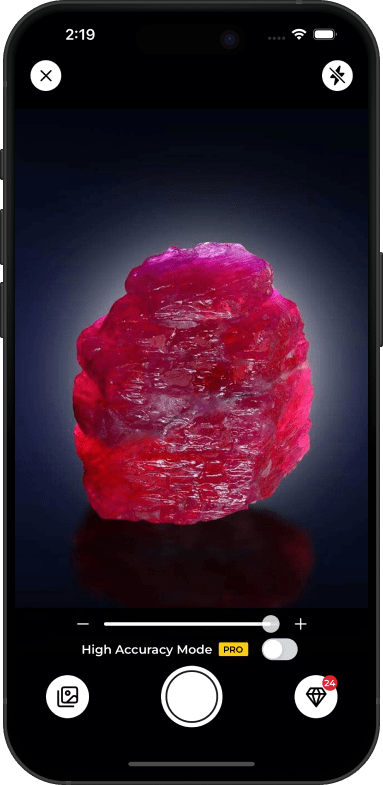
Identify Akimotoite Instantly
- Snap a photo, get instant results
- 6,700+ rocks, minerals & crystals
- Discover collecting spots near you
Akimotoite FAQs
How do I identify Akimotoite?
Akimotoite can be identified by its colourless color. Look for these key characteristics when examining specimens.
What color is Akimotoite?
Akimotoite typically appears in colourless. Color can vary depending on impurities and formation conditions.
What is the formation of akimotoite of Akimotoite?
Akimotoite was found in the Tenham meteorites in Queensland, Australia. It is believed to have formed as the result of an extraterrestrial shock event. It is the silicon analogue of geikielite (MgTiO3). It was named after physicist Syun-iti Akimoto (also known as Shun'ichi Akimoto (秋本 俊一)) (1925–2004), University of Tokyo. It has also been reported from the Sixiangkou meteorite in the Gaogang District, Jiangsu Province, Taizhou Prefecture, China; the Zagami Martian meteorite, Katsina State, Nigeria and from the Umbarger meteorite, Randall County, Texas. Akimotoite is believed to be a significant mineral in the Earth's mantle at depths of 600–800 kilometres (370–500 mi) in cooler regions of the mantle such as where a subducted slab enters into the lower mantle. Akimotoite is elastically anisotropic and has been suggested as a cause of seismic anisotropy in the lower transition zone and uppermost lower mantle.
What is the composition of akimotoite of Akimotoite?
The crystal structure is similar to that of ilmenite (FeTiO3) with Si and Mg in regular octahedral coordination with oxygen. The Si and Mg octahedra align in discrete layers alternating up the c-axis. The space group is R3 (trigonal) with a = 4.7284 Å; c = 13.5591 Å; V = 262.94 Å; Z = 6.

%252FAbenakiite-(ce)-01.jpg&size=small)

