Ajoite
A variety of Minerals

What is Ajoite?
Ajoite is a hydrated sodium potassium copper aluminium silicate hydroxide mineral. Ajoite has the chemical formula (Na,K)Cu7AlSi9O24(OH)6·3H2O, and minor Mn, Fe and Ca are usually also present in the structure. Ajoite is used as a minor ore of copper.
Market Value Factors
Pricing varies for every rock and mineral, so use these universal factors to gauge Ajoite before comparing listings or appraisals.
Size & Weight
Larger, intact specimens usually command higher prices.
Rarity & Demand
Scarce material or popular varieties sell at a premium.
Condition & Finish
Chips, repairs, and heavy wear lower value; clean prep helps.
Treatment & Provenance
Untreated specimens with documented locality are prized.
Ajoite Localities Map
See where Ajoite is found with a localities map, collecting zones, and geology context. Generate a sample map preview below.
Key Characteristics
Characteristics of Ajoite
The cleavage is perfect parallel to the plane containing the a and c axes, and the hardness is 3.5, between that of calcite and fluorite. It is a little denser than quartz, with specific gravity 2.96. Ajoite is readily decomposed by hydrochloric acid, HCl, and by nitric acid, HNO3, but it does not react with ammonium hydroxide, NH4OH. It has been reported as having barely detectable radioactivity.
Formation of Ajoite
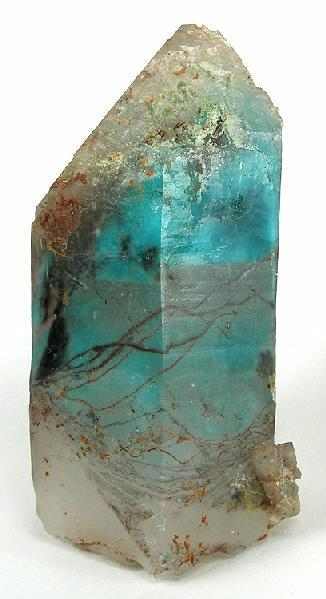
Ajoite is named after its type locality, the New Cornelia Mine in the Ajo District of Pima County, Arizona. Type material is conserved at the National Museum of Natural History, Washington DC, USA, reference number 113220. Other localities include Wickenburg and Maricopa County in Arizona, within the United States, and the Messina (Musina) District in South Africa. Quartz specimens from the defunct Messina Mines on the border between Zimbabwe and South Africa are well known for their inclusions of blue copper silicate minerals such as shattuckite, papagoite and ajoite, but ajoite from American localities does not occur like this.
Composition of Ajoite
The 1981 investigations of ajoite were done on a sample from the New Cornelia Mine, Ajo, with tiny crystals averaging 0.01×0.1×0.4 mm. The mineral was shown to belong to the triclinic system, but it was not clear whether the crystal class was 1 or 1. The triclinic class 1 has the lowest possible symmetry with no symmetry elements at all, and 1 has just a centre of symmetry, but no axes of symmetry or mirror planes. The space group is either P1 or P1. The unit cell parameters are: a = 13.637 Å, b = 14.507 Å, c = 13.620 Å, α = 107.16°, β = 105.45° and γ = 110.57°. Ajoite occurs as sprays of bladed prismatic crystals, commonly fibrous, elongated along the c crystal axis and flattened sideways. The dominant form is {010}, parallel to the plane containing the a and c axes. The forms {110}, cutting both the a and b axes, and {100}, parallel to the plane containing the b and c axes, are much less prominent but are always present. The termination on c may be either {001} or {203} or both. Ajoite is frequently found as inclusions in quartz, much sought after by mineral collectors.
More Images
Quick Facts
Physical Properties
- Color
- Bluish green
- Density
- 2.951 g/cm³
- Streak
- Greenish white
Chemical Properties
- Chemical Formula
- (K,Na)Cu7AlSi9O24(OH)6 · 3H2O
- Elements
- Al, Cu, H, K, O, Si
Identify Ajoite Instantly
- Snap a photo, get instant results
- 6,700+ rocks, minerals & crystals
- Discover collecting spots near you
Ajoite FAQs
How do I identify Ajoite?
Ajoite can be identified by its Bluish green color. Look for these key characteristics when examining specimens.
What color is Ajoite?
Ajoite typically appears in Bluish green. Color can vary depending on impurities and formation conditions.
What is the characteristics of ajoite of Ajoite?
The cleavage is perfect parallel to the plane containing the a and c axes, and the hardness is 3.5, between that of calcite and fluorite. It is a little denser than quartz, with specific gravity 2.96. Ajoite is readily decomposed by hydrochloric acid, HCl, and by nitric acid, HNO3, but it does not react with ammonium hydroxide, NH4OH. It has been reported as having barely detectable radioactivity.
What is the formation of ajoite of Ajoite?
Ajoite is named after its type locality, the New Cornelia Mine in the Ajo District of Pima County, Arizona. Type material is conserved at the National Museum of Natural History, Washington DC, USA, reference number 113220. Other localities include Wickenburg and Maricopa County in Arizona, within the United States, and the Messina (Musina) District in South Africa. Quartz specimens from the defunct Messina Mines on the border between Zimbabwe and South Africa are well known for their inclusions of blue copper silicate minerals such as shattuckite, papagoite and ajoite, but ajoite from American localities does not occur like this.
What is the composition of ajoite of Ajoite?
The 1981 investigations of ajoite were done on a sample from the New Cornelia Mine, Ajo, with tiny crystals averaging 0.01×0.1×0.4 mm. The mineral was shown to belong to the triclinic system, but it was not clear whether the crystal class was 1 or 1. The triclinic class 1 has the lowest possible symmetry with no symmetry elements at all, and 1 has just a centre of symmetry, but no axes of symmetry or mirror planes. The space group is either P1 or P1. The unit cell parameters are: a = 13.637 Å, b = 14.507 Å, c = 13.620 Å, α = 107.16°, β = 105.45° and γ = 110.57°. Ajoite occurs as sprays of bladed prismatic crystals, commonly fibrous, elongated along the c crystal axis and flattened sideways. The dominant form is {010}, parallel to the plane containing the a and c axes. The forms {110}, cutting both the a and b axes, and {100}, parallel to the plane containing the b and c axes, are much less prominent but are always present. The termination on c may be either {001} or {203} or both. Ajoite is frequently found as inclusions in quartz, much sought after by mineral collectors.

%252FAbenakiite-(ce)-01.jpg&size=small)

